Western Intelligence: Russia Could Launch Nuclear-Armed Satellite Sputnik-S Within 60 Days – HobbyMiliter.com – Russia could launch a nuclear-capable satellite into orbit in less than 60 days, according to Western intelligence assessments reported in a joint German media investigation on Monday, November 23, 2026. The report says the satellite, named Sputnik-S, was assembled several years ago and has been stored in the Moscow region.
The joint investigation by broadcasters WDR and NDR and the newspaper Süddeutsche Zeitung cited Western intelligence and military services, including Germany’s foreign intelligence service, the BND, and the German armed forces, the Bundeswehr. According to the report, intelligence warnings shared with several NATO member states in early November said the satellite, designed to carry a nuclear warhead, could be launched within 60 days and become operational shortly after reaching orbit. Germany’s military Space Command assessed that a December launch was still possible, and German military officials were reported to have briefed Defense Minister Boris Pistorius about the threat.
The report drew an immediate response from European leaders. German Chancellor Friedrich Merz called the report shocking as he appeared alongside NATO Secretary General Mark Rutte in Berlin on Monday. Rutte stressed that NATO keeps assessing its defensive capabilities. “I can assure you, we will always make sure that we defend every inch of NATO territory,” Rutte said, as quoted by Reuters. He added that the alliance’s defense planning covers threats in space.
The Kremlin rejected the report the same day. Kremlin spokesman Dmitry Peskov questioned the credibility of the report, dismissing it as unsubstantiated. “We haven’t seen the report. But there are so many ‘alleged’ and ‘possible’ claims in it, attributed to who knows whom, that it’s certainly hardly worth taking them seriously,” Peskov told reporters. The Russian Embassy in Berlin called the report part of a propaganda campaign and said it had no information about the alleged deployment.
The concern is not new, but the latest report puts a more concrete deadline on it. The U.S. Defense Intelligence Agency (DIA), in its Challenges to Security in Space 2026 assessment published in October 2026, stated openly, “Russia is developing a satellite designed to carry a nuclear weapon.” The DIA warned that such a weapon could cause the rapid loss or degradation of thousands of satellites. A similar warning first reached the public in February 2024, and the White House then confirmed that the capability in question was a Russian space-based anti-satellite weapon that would breach the Outer Space Treaty, while stressing that the weapon had not been deployed.
The main threat from such a weapon is not an attack on targets on the ground, but on other satellites. A nuclear explosion in orbit would not need to hit anything. The radiation and electromagnetic pulse (EMP) it produces could damage large numbers of satellites at once. U.S. Space Command chief General Stephen Whiting warned in April 2026 that all of low Earth orbit would be at risk, and that more than 10,000 satellites now fly there. A 2025 RAND study found that a single blast of 110 kilotons or more at an altitude of 400 kilometers could immediately endanger up to about 20 percent of satellites in low Earth orbit.
The consequences would reach far beyond military affairs. Satellites support GPS navigation, international communications, financial transactions, weather forecasting, and critical infrastructure. Ukraine’s military relies heavily on satellite communications, including SpaceX’s Starlink network.
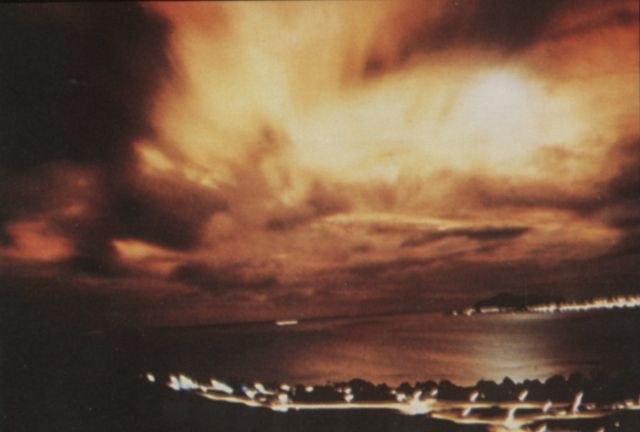
History shows what happens when a nuclear weapon is detonated at altitude. On July 9, 1962, the United States detonated a 1.4-megaton warhead about 400 kilometers above Johnston Island in the Starfish Prime test. Streetlights went out in Hawaii, about 1,450 kilometers away, and its artificial radiation belt damaged several satellites, including Telstar. That experience was one reason the 1967 Outer Space Treaty bans the placement of nuclear weapons in Earth orbit. The Soviet Union signed the treaty, and Russia remains bound by it.
Western suspicion of Russia’s space program has long focused on the Kosmos 2553 satellite, launched in February 2022 into an orbit about 2,000 kilometers up, in a region of intense natural radiation. Russia calls it a research satellite, but U.S. officials say the spacecraft supports the development of a nuclear anti-satellite weapon.
The latest report came only four days after U.S. President Donald Trump met Russian President Vladimir Putin and Chinese President Xi Jinping at a summit in Shenzhen, China, which discussed nuclear arms control, according to Fox News. The three leaders issued a joint declaration affirming that nuclear war should never be fought, but announced no binding arms-control commitments.
Even so, important questions remain unanswered. No intelligence documents or satellite imagery have been published to confirm the deployment of Sputnik-S, and the assessment has not been independently verified. It is still unclear whether the satellite already carries a nuclear warhead or whether Western intelligence has verified the reported launch preparations. According to the German investigation, Western intelligence services now assess the threat as closer than before, and NATO says it will keep assessing the situation.
Source: Fox News, Reuters, MiGFlug.