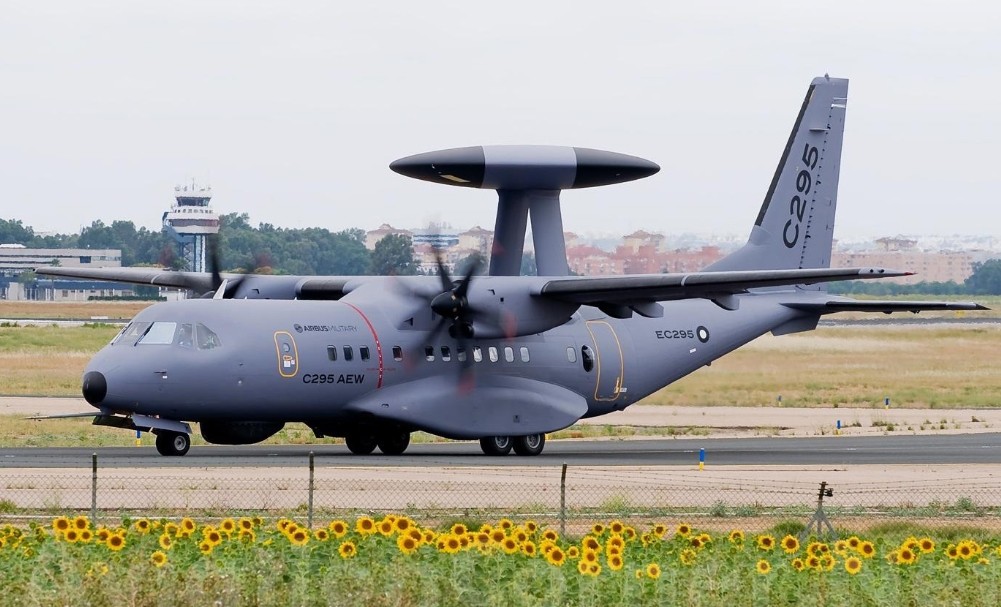
Getting to Know AWACS – HobbyMiliter.com – Air warfare is growing ever more complex as it involves advanced technology and mastery of information. The concepts of early warning and first look, first kill are two things that are vital to mastering the battlefield and winning it at the same time.
The problem is, how do you gather as much information about the battlefield situation as possible, as completely as possible and as efficiently as possible. This concept was then formulated, so that the information obtained is comprehensive and can be distributed to the warfighting systems in real time.
One element that supports achieving ISTAR superiority (Intelligence, Surveillance, Target Acquisition, and Reconnaissance) is none other than the use of Airborne Early Warning and Control (AEW&C) aircraft.
This aircraft, if you use an analogy, will act as a control tower regulating all warfighting assets, especially aircraft and other air assets. The AEW&C aircraft provides as much information as possible about the battlefield.

A flying radar has an advantage over radar planted fixed on the ground because its movement is highly mobile. A fixed radar, once its position is known to the enemy, will become a target that the enemy will destroy first by any means (even in the case of Israel versus Egypt, Soviet-made Egyptian radar was stolen by Israel).
Another advantage is the greater chance of detecting fighter aircraft designed with a small RCS (stealth), because the upper side of a stealth fighter usually still has a control surface with a larger RCS than the underside.
Indonesia is one country currently exploring the purchase of an AEW&C aircraft. Indonesia also plans to buy tanker jets to meet its minimum essential force needs.
AWACS or AEW&C?
Quite a few laypeople, or even the media, are confused about which term to use: AEW&C or AWACS? In truth, the two terms mean the same thing. The terminology AEW&C (Airborne Early Warning and Control) began to appear in the 1970s, as a continuation or upgrade of the capability of the early generation AEW (Airborne Early Warning) function that had appeared since the 1950s.
Unlike AEW, whose main mission is merely that of a flying radar, AEW&C has control, execution and battle management capability, also known as C2BM (Command, Control and Battle Management).

Meanwhile, the term AWACS (Airborne Warning And Control System) itself is the terminology used when the United States Air Force (USAF) introduced its early warning aircraft program in the 1970s.
And in fact, the term still commonly used by defence industry practitioners and military aviation technology experts is AEW&C. The term AWACS itself is more commonly used by US military circles and the popular media. Perhaps also because it rolls off the tongue more easily, AWACS rather than AEW&C.

Below are some of the AEW&C/AWACS aircraft already in operation and used as one element of modern air combat power in several countries, and worth considering as candidates for the Indonesian Air Force AWACS:
AWACS BOEING E-3 SENTRY
This is the first generation of AWACS, and the system that would later popularise the term itself. Its role is vital as an air choreographer for the air power of the US superpower. The US never sends its air combat forces without AWACS escort. Although it has been operational since the 1970s, technologically it is always kept up-to-date, because the US frequently upgrades its capability regularly, in a planned and sustained way.

Its physical hallmark became the generic configuration and a kind of template for other AEW systems, namely the radar dish carried on the back of the aircraft. The dish, which is the radar antenna itself, is enclosed in material transparent to radar waves.
Besides its high price, sales of the Sentry are often limited by strong political factors. Saudi Arabia, which succeeded in getting approval to buy this aircraft, immediately rose in status to become a key United States ally in the Middle East, even though the sale drew a strong reaction from Israel, another key United States ally in the region and a rival of Saudi Arabia.

Prime Contractor: Boeing, USA
Platform: Boeing 707
Variants (users): E-3A/B/C/G (USA), E-3D (United Kingdom), E-3F (France), E-3A (Saudi Arabia, Belgium-NATO)
First operational: 1977
Max speed: ± 850 km/h
Flight range: ± 7,400 km
Max. Endurance: 18 hours
Maximum flight altitude: 12,500 m
NORTHROP GRUMMAN E-2 HAWKEYE
If the US Air Force has the E-3 Sentry, then the US Navy has the E-2 Hawkeye. Its role and mission are the same, only its base is different. Although it can be based on land, the main base of the Hawkeye, often nicknamed the mini AWACS, is the US Navy supercarriers.

Although its range and flight speed are below the Sentry, the Hawkeye’s sensor capability is not far behind. Its sensor capability makes the Hawkeye the main sense organ of the US carrier battle group fleet.
In every movement, especially when entering a danger zone, the Hawkeye often patrols at a considerable distance from the carrier concerned. This gives the fighter aircraft on that carrier enough space and time to react if a threat is detected.
Prime Contractor: Northrop Grumman, USA
Variants (Users): E-2A/B (USA), E-2C (USA, France, Israel, Japan, Singapore, Taiwan, Mexico, Egypt), E-2C Hawkeye 2000 (France, Egypt, Taiwan), E-2D Advanced Hawkeye (USA)
First operational: 1965
Max speed: ± 600 km/h
Flight range: ± 2,600 km
Max. Endurance: ± 5 hours
Maximum flight altitude: 9,100 m
BOEING E-767 AWACS
This is the latest generation of the US-made AWACS system. This aircraft was made specifically to meet the needs of the Japan Air Self-Defense Force, which needed an AEW&C aircraft with speed and flight range exceeding the Hawkeye. Although its system is the same as that fitted to the upgraded US Sentry fleet, Japan chose a newer platform than the Boeing 707, namely the Boeing 767-200ER.

In terms of carrying capacity, the Boeing 767 was chosen because it is larger than the Boeing 707. This aircraft has a cabin floor 50 percent wider than the Boeing 707 and twice the interior volume. The radar fitted to the E-767 uses multimode, so it can separate targets at sea and on the surface.
The radar can sweep targets through 360 degrees with a range of more than 320 km. The aircraft’s cruising range reaches 10,370 km and its endurance is 13 hours. Its MTOW reaches 175 tons.
Prime Contractor: Boeing, USA
Platform: Boeing 767-200ER
Variants (Users): E-767 (Japan)
First operational: 2000
Max speed: ± 900 km/h
Flight range: ± 10,300 km
Max. Endurance: ± 13 hours
Maximum flight altitude: 12,200 m
SAAB ERIEYE
This system is called one of the most advanced AWACS in the world outside US-made AEW&C equipment. Its scanning mechanism already follows the latest technology, namely active electronically-scanned array or AESA (active electronically-scanned array). Its maker designed the Erieye as a fully modular system, so it can be fitted to several different aircraft platforms without significant changes.

Operationally successful in the Swedish Air Force, Sweden was confident enough to significantly upgrade its capability and offer it on the export market. Besides the AEW&C version, the manufacturer also launched a special variant for maritime patrol.
Prime Contractor: Saab, Sweden
Platform (Variants): Saab 340 (S100B Argus), Saab 2000 (Saab 2000 AEW&C), Embraer EMB-145 (R-99)
Variants (Users): S100B Argus (Sweden, Thailand, Pakistan, United Arab Emirates), Saab 2000 AEW&C (Sweden), R-99 (Brazil, Greece, Mexico, India)
First operational: 1996
Max speed: ± 400 km/h (S100B), ± 600 km/h (Saab 2000), ± 800 km/h (R-99). Depending on the platform where ERIEYE is installed.
Flight range: ± 3,000 km (R-99), ± 2,000 km (S100B). Depending on the platform where ERIEYE is installed.
Max. Endurance: ± 6 hours (S100B), ± 4 hours (R-99). Depending on the platform where ERIEYE is installed.
Maximum flight altitude: 11,200 m (R-99), 7,600 m (S100B), 9,000 m (Saab 2000). Depending on the platform where ERIEYE is installed.
PHALCON GULFSTREAM G550 CAEW/EITAM
Although it cannot yet match the Erieye in sales, this AEW&C system is called a strong rival to the Erieye in sophistication. Some media even call it the most advanced outside the US.

The latest generation Phalcon relies on the Elta EL/W-2085 AESA radar fitted to the Gulfstream G550 business jet. This combined system is often labelled CAEW (Conformal Airborne Early Warning) because its radar is fitted protruding from the fuselage, not as a dish above the aircraft.
Before the latest generation, Israel and Chile already operated the first generation Phalcon, which relied on the Elta EL/W-2075 radar fitted to the Boeing 707. The most prominent physical feature of this first generation is the nose of the aircraft, which looked less than proportional because it was shaped as a large PHALCON bulge. Now only Chile still operates the first generation under the name Condor, while Israel has replaced it with the Eitam.

Prime Contractor: IAI, Israel
Platform: Gulfstream G550
Users: Israel, Singapore
First operational: 2007
Max speed: ± 900 km/h
Flight range: ± 11,000 km
Max. Endurance: ± 10 hours
Maximum flight altitude: 15,500 m
Boeing E-7A WEDGETAIL
Not wanting to miss the train, seeing Saab’s aggressive marketing of the Erieye and the strong aura of sophistication around the Phalcon, the United States again launched the latest generation of AEW&C for the international market, fitted to the Boeing 737NG platform. Its main radar is an electronically scanned type, the MESA (Multi-role Electronically-Scanned Array) made by Northrop Grumman.

This Boeing 737 AEW is offered specifically to each customer’s needs, so between one customer and another there are differences in electronic specifications, customised to the customer’s wishes. Australia, for example, ordered a special specification, so it differs from those owned by Turkey and South Korea, although the main mission system remains the same.
The Boeing 737 base aircraft was chosen clearly after careful consideration. As is known, this aircraft sells well around the world. Spare parts are easy to obtain.

Prime Contractor: Boeing, USA
Platform: Boeing 737NG
Users (program/variant): Australia (Wedgetail), South Korea (Peace Eye), Turkey (Peace Eagle)
First operational: 2009
Max speed: ± 900 km/h
Flight range: ± 6,400 km
Max. Endurance: ± 6 hours
Maximum flight altitude: 12,500 m
BERIEV A-50 MAINSTAY
The configuration chosen by the Soviet Union (later continued by Russia) for this AEW&C aircraft, NATO codename Mainstay, is not far different from that adopted by the US. The rotating radar dish is fitted on the rear upper fuselage. As its platform, Russia relies on the Ilyushin Il-76 heavy military transport aircraft base.

Although often called far inferior to the E-3 Sentry, the A-50 has had a long career. This is proven by the launch of the newest variant, the A-50U, in 2011, before the next variant, the A-100, appeared.
Besides Russia, users of the A-50 are India and China. China fits its own radar and combines it with several subsystems still supplied by Russia. India, meanwhile, relies on the Elta radar from the Phalcon system, an Israeli product.

Prime Contractor: Beriev, Russia
Platform: Ilyushin Il-76
Variants (Users): A-50/A-50U (Russia), India (A-50EI), China (KJ-2000)
First operational: 1984
Max speed: ± 900 km/h
Flight range: ± 6,000 km
Maximum flight altitude: 12,000 m
So, according to readers, which one is the most suitable for the Indonesian AWACS?