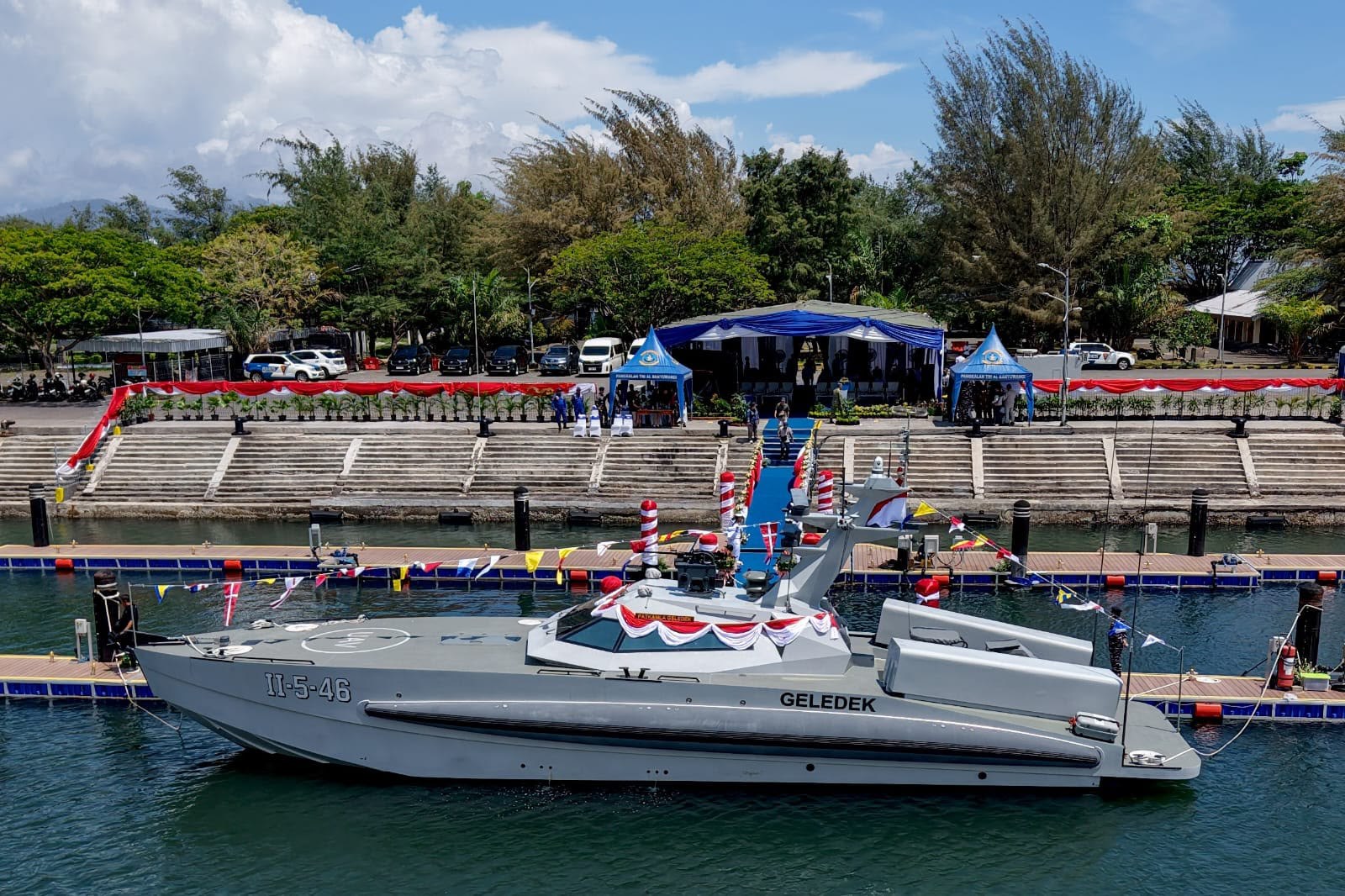
Patkamla Geledek – HobbyMiliter.com – The Indonesian Navy has officially strengthened its fleet with its first domestically built unmanned attack craft. PT Lundin Industry Invest, also known by its trading name North Sea Boats (a Banyuwangi-based shipyard), delivered the X33 light attack craft to the Indonesian Navy at a commissioning ceremony at the Pantai Boom Marina pier in Banyuwangi, East Java, on Wednesday, 25 November 2026. The vessel has entered service as Patkamla Geledek with hull number II-5-46.
Patkamla is short for Maritime Security Patrol, while Geledek means thunder, a name that reflects the vessel’s high-speed character. According to the company, Geledek is the first vessel capable of unmanned operations to be formally designated as a naval vessel in Indonesian Navy service. At the same ceremony, the Navy also inaugurated the first commanding officer of Patkamla Geledek.
The delivery closes out a Ministry of Defence procurement programme from fiscal years 2020–2024 allocated to the Indonesian Navy. Geledek’s status as a naval vessel was established by Chief of Naval Staff Decision No. Kep/2334/XI/2026 dated 18 November 2026. The vessel will strengthen a naval base within the area of the 5th Naval Regional Command (Kodaeral V) in Surabaya, which oversees maritime defence across central and eastern Java as well as Bali. The ceremony was attended by Deputy Commander of Kodaeral V Marine Brigadier General Suwandi, representing Commander of Kodaeral V Rear Admiral Ali Triswanto, and was marked by a ribbon cutting and siren press by the Ministry of Defence Expert Staff for Defence Industry, Air Vice Marshal Wajariman, Head of the Naval Procurement Service Rear Admiral Ifa Djaya Sakti, and President Director of PT Lundin Industry Invest Lizza Lundin.
In terms of platform, the KSR X33 is a 20-metre vessel with a beam of 4.6 metres, a draught of 1.2 metres, and a displacement of 33 tonnes. It carries 5,000 litres of fuel and 600 litres of fresh water. Power comes from two MAN V12-2000 engines driving twin Kongsberg Kamewa waterjets. During sea trials, the craft reached 58 knots, exceeding its contractual requirement of 50 knots. At a cruising speed of 30 knots, its range reaches 330 nautical miles, and that figure rises to 600 nautical miles at an economical speed of 9 knots.
The entire hull is built from carbon-fibre composite using the vacuum infusion method and fire-resistant resin. According to the company, the lightweight, non-magnetic hull lowers the vessel’s radar, infrared, and magnetic signatures while cutting fuel consumption and maintenance demands. These characteristics were designed for coastal and littoral warfare, particularly in choke points and strategic archipelagic sea lanes that serve as vital traffic routes for Indonesia.
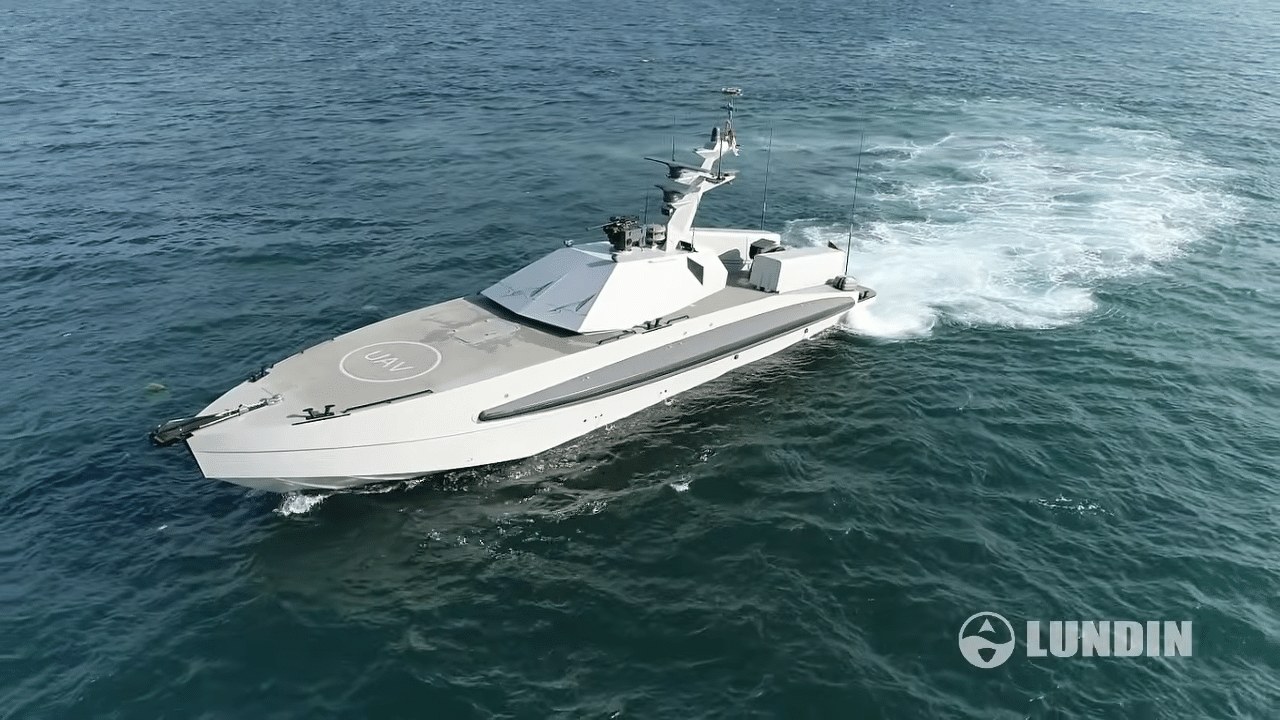
For armament, Geledek is fitted with a 12.7 mm remote weapon station and is configured to carry two long-range anti-ship missiles with a range of up to 300 kilometres, although the missile type has not been disclosed to the public. Naval News reported that the original plan at Indo Defence 2025 was to equip the KSR X33 with Kongsberg’s Naval Strike Missile, and the launch canisters on the first vessel do resemble those of that missile. Still according to Naval News, if the class enters mass production for the Indonesian Navy, its armament will highly likely switch to the Çak?r missile made by Roketsan of Türkiye. The vessel can also carry an optronic surveillance system, soft-kill countermeasures against enemy drones and unmanned vessels, and a tethered quadcopter to extend its reconnaissance reach.
Its most prominent capability is its unmanned operating mode. For manned missions, the vessel carries a crew of six, while for unmanned missions Geledek relies on encrypted communication links, including satellite communications. North Sea Boats founder and director John Lundin told Naval News that Geledek uses Kongsberg technology for AI-based unmanned operations, with autonomous navigation and collision avoidance designed to comply with the International Regulations for Preventing Collisions at Sea, COLREGs. Its data-link-enabled combat management system allows the vessel to exchange information with other platforms, enabling coordinated operations such as swarm attacks, over-the-horizon targeting, and long-range intelligence gathering.
The programme does not stop at one vessel. Lundin said three additional vessels are on order with a slightly larger design capable of carrying four missiles, with delivery to the Indonesian Navy targeted for 2027. Unlike Geledek, which uses Kongsberg solutions for its unmanned functions, the forthcoming vessels will use systems from Türkiye’s Aselsan. The company’s production facilities are currently running at full capacity for the next two years due to the KSR programme and several other projects. The KSR X33 has also attracted interest from potential overseas buyers, particularly in the Middle East, and the company is preparing a dedicated one-way attack, or kamikaze, unmanned vessel for testing.
Air Vice Marshal Wajariman stressed in his remarks the importance of domestic assets for Indonesia’s maritime defence. “The Ministry of Defence wants to safeguard the sovereignty of the Republic of Indonesia using domestic assets,” he said. John Lundin also expressed his pride that a vessel designed and built by Indonesians in Banyuwangi, at a 50,000 square metre shipyard facility, now officially sails as an Indonesian Navy vessel. The entry of Geledek marks a new chapter for the Indonesian Navy, which now operates a fast, missile-armed unmanned attack craft designed and produced by its own national defence industry.
Source: Naval News, Indonesia Defense, the Indonesian Navy’s official website (tnial.mil.id)