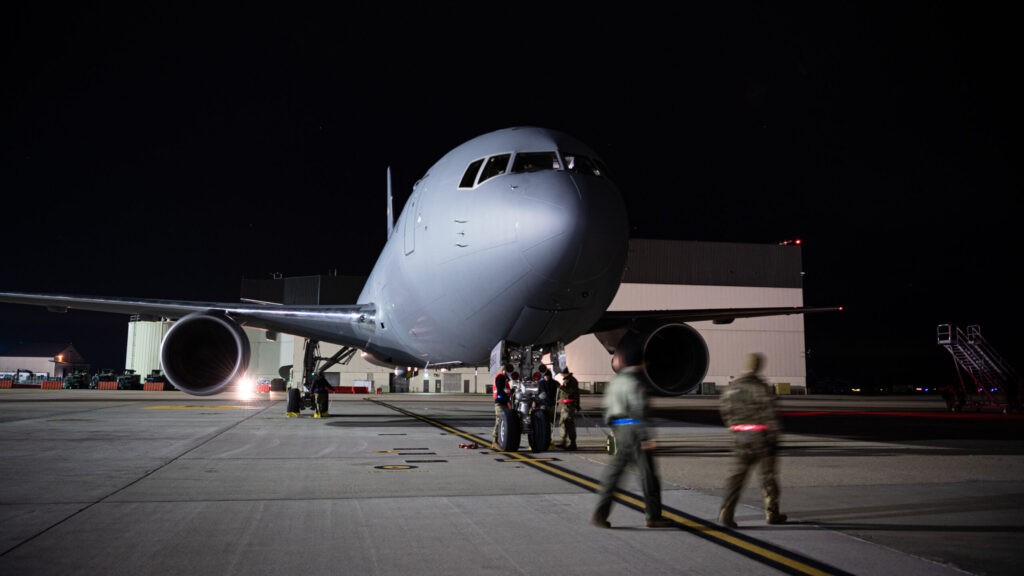
US Air Force Orders Final 15 KC-46A Pegasus Tankers from 2011 Contract in $2.82 Billion Deal – HobbyMiliter.com – The United States Air Force has ordered 15 additional KC-46A *Pegasus* tankers from Boeing in a $2.82 billion contract announced by the Pentagon on Tuesday, November 24, 2026. The order closes out the production run in the original 2011 tanker program contract.
The contract covers 15 Lot 13 production aircraft plus maintenance data support, subscriptions, and licenses. The aircraft will be built in Seattle and completed by June 30, 2030. The full $2,819,046,560 comes from fiscal year 2027 aircraft procurement funds.
The Lot 13 price rose sharply from the previous lot. Lot 12, ordered in November 2025, held the same 15 aircraft at $2.47 billion, so Lot 13 costs about $349 million more. The increase is about 14.2 percent in one year, or almost $188 million per aircraft. That figure includes support services and licenses, so it is not a *flyaway* price.
With Lot 13, the total number of KC-46As on contract or in service worldwide reaches 203. Boeing says it has delivered 116 aircraft to the United States Air Force, six to Japan, and two to Israel. The first aircraft was delivered in 2019, and since then the United States fleet has flown more than 180,000 hours.
The order is part of an Air Force effort to renew its old tanker fleet. The KC-46A is being bought to replace the KC-135 *Stratotanker*, produced between 1955 and 1965 in 803 units and first entering service in June 1957. The younger tanker, the KC-10 *Extender*, was retired in 2024. The Air Force plans a total of 263 KC-46A aircraft.
The KC-46A was developed from the Boeing 767 airliner. The aircraft is 50.5 meters long with a wingspan of 48.1 meters, powered by two Pratt and Whitney PW4062 engines, with a maximum takeoff weight of 188,240 kilograms. Its maximum speed reaches 914 kilometers per hour and its range is 11,830 kilometers. It is crewed by two pilots and one aerial refueling operator, and it can also carry 18 cargo pallets, 58 passengers, or 24 litters.
The KC-46A has three ways to refuel other aircraft. It can refuel through a rear *boom*, a centerline hose and *drogue*, or wing-mounted refueling pods. That combination lets it serve Air Force receivers that use a *receptacle* and Navy and Marine Corps aircraft that use a *probe* on the same mission. The aircraft is also often used for humanitarian missions.
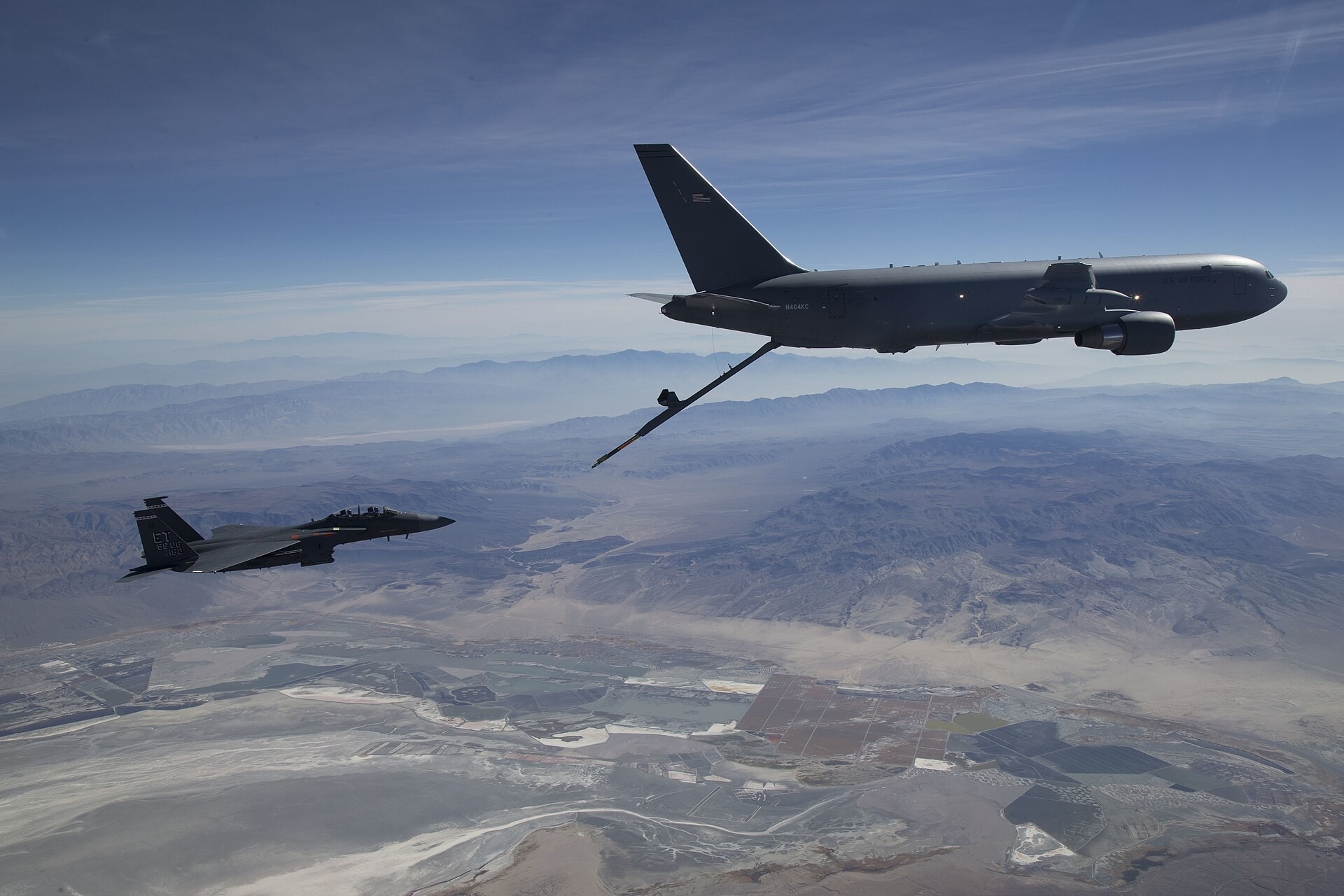
The KC-46A program is also known as one of the most troubled procurement programs in Air Force history. The best-known problem involves the *Remote Vision System*, or RVS, the camera system that steers the *boom* toward the receiving aircraft. On the KC-46A, the operator sits behind the cockpit and steers the *boom* by watching camera images on screens, while on the KC-135 the operator lies at the rear and looks out a window. The original system sometimes produced distorted images and responded too slowly to changing light. According to Defence Blog, the fleet even lost two *booms* in flight within one year. The fix, RVS 2.0, brings better cameras, color video, and better depth perception. Boeing said in June 2026 that first-phase RVS 2.0 flight testing was complete. Defense News reported the new system enters service in the summer of 2027, while Air and Space Forces Magazine reported installation starts in late 2027 and early 2028.
Fleet readiness is also still a problem. Defence Blog recorded a KC-46A *mission capable rate* of only 62 percent in 2024, the last year the Air Force released the figure. In May 2026, the Air Force and Boeing agreed on a plan expected to raise aircraft availability by more than 20 percent by 2030.
For Boeing, the program is also expensive. The KC-46A is built under a *fixed-price* contract, so Boeing bears the cost overruns. The company has recorded losses of more than $7 billion on the program, including a $565 million charge in January 2026. Boeing Chief Executive Kelly Ortberg called the program a bad contract for the last decade.
Lot 13 does close the 2011 contract, but the KC-46A story is not over. In 2024, the Air Force decided to buy up to 75 more aircraft through the *Tanker Production Extension* program, bringing the planned total fleet to 263 aircraft. The contract for those 75 aircraft has not been signed yet. Gen. John D. Lamontagne, Vice Chief of Staff of the Air Force, said in March 2026 that the Air Force will not sign a new contract until the aircraft shortcomings are fixed, and according to Defense News he estimated a decision is about two years away.
Outside the United States, the KC-46A keeps attracting buyers. Japan has bought six aircraft and is cleared for nine more. Israel bought six of eight aircraft cleared in a $2.4 billion sale in March 2020 and has received two aircraft. Qatar was cleared on August 20, 2026, to buy up to four aircraft worth $4.5 billion. With Lot 13 now ordered, attention turns to whether Boeing can fix the shortcomings on time.
Source: Defense News, Air and Space Forces Magazine, Breaking Defense, Boeing, Army Recognition, Defence Blog.