
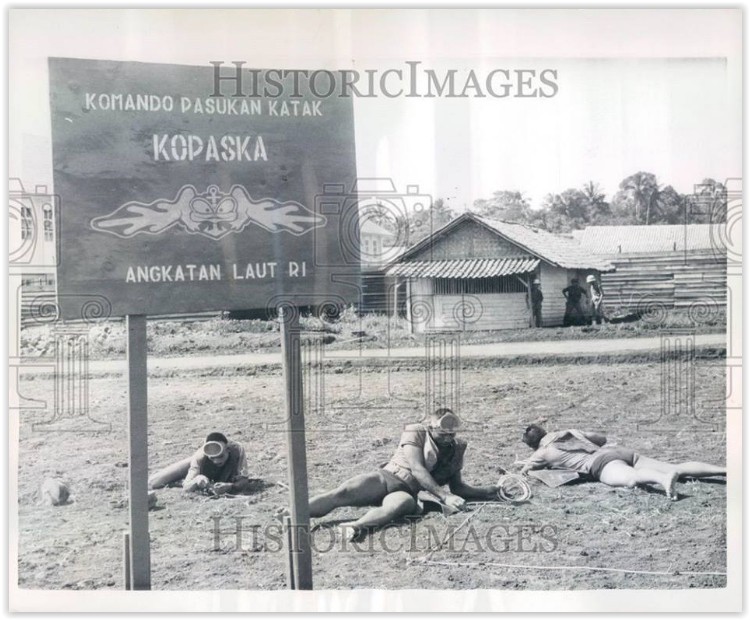
The Story of the Kopaska TNI AL Frogmen’s Sabotage Action in Johor, Malaysia – HobbyMiliter.com – Entering 1961, Indonesia, as a young nation, was involved in a dispute with the Dutch government over the status of Papua. Annoyed by The Hague’s stubborn stance, at the end of 1961 President Soekarno proclaimed the Tri Komando Rakyat (Trikora). It was spelled out through Operation Jayawijaya. Unfortunately, the operation, which mobilized most of the ABRI’s strength, was never carried out because the diplomatic route succeeded.
Before Trikora was settled, the proclaimer of the Republic then opposed the Federation of Malaya, which he regarded as merely a British creation as part of a colonial project in Southeast Asia. The issue raised was the ‘independence’ movement of the State of North Kalimantan (NKU), initiated by the local figure Tengku Azahari. Also challenged was the military cooperation pact between Britain and the Federation of Malaya. Under this pact, Britain had the right to use the military base in Sembawang (Singapore) for 99 years.
To support the NKU and counter the British-Federation of Malaya military pact, Pak Karno then proclaimed the Dwi Komando Rakyat (Dwikora) on 3 May 1964 at a mass rally in Jakarta. As with Trikora, Jakarta again sent thousands of ‘volunteers’ to take part in various secret missions in the border region. The core strength of these volunteer forces was in fact ABRI personnel. One of them was of course the Komando Pasukan Katak (Kopaska).
The number of Kopaska frogmen personnel after Trikora was very small. Even so, this did not stop the ABRI leadership from involving this small unit in the G-1/Intelligence section of the Supreme Operations Command (KOTI) for Dwikora. So that its personnel needs could be met in a short time even though the country was in a critical situation, in early 1963 recruitment to become frogmen was opened at every TNI AL base.
One of the TNI AL enlisted men who took part in that selection was Kopda Laut Soewarno, based at the Palembang Naval Station (Sional). Amid the boredom of routine duties, he was drawn to the announcement seeking volunteers to be trained as frogmen. Of the thousands of applicants, only he and eight other TNI AL personnel were declared eligible to attend the Sekolah Komando Chusus Sukarelawan (SKCS) in the Cipulir area of South Jakarta. This school was deliberately established as part of a ‘crash program‘ to produce new frogmen personnel.
Infiltration by Kopaska Frogmen in Malaysia
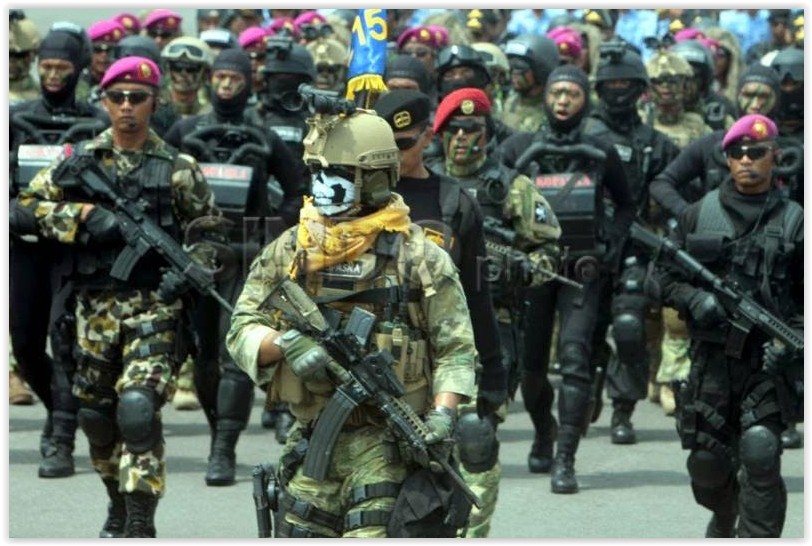
Not long after graduating from SKCS, in the middle of March Soewarno and five of his fellow frogmen were sent to the intelligence command post on Sekupang Island (Riau Islands) to join their seniors. Through the direction of a TNI AL intelligence officer named Bambang Pratomo, from there Kopaska personnel were sent one by one to carry out high-risk secret missions deep inside enemy territory. The tasks Bambang Pratomo gave to the Kopaska personnel were always delivered verbally, to minimize the risk of leaking to the enemy.
After several frogmen had been sent to penetrate enemy territory, at last it was Kopda Laut Soewarno’s turn. All the supporting documents for his operation had been prepared by the Central Intelligence Agency (BPI) in Jakarta. They included a fake ID card from Lengkang Island district (Riau) in the name of Junus bin Usman. Soewarno was not alone. He was accompanied by Serda Laut Prijatna DN, who received the new name Soleh bin Amir. Both posed as rubber smugglers.
The task given to the two Kopaska personnel was quite ‘crazy’. It was to destroy the water pipeline at Mount Muntaha (Johor). This installation was extremely vital because it supplied drinking water for most of the population of the Federation of Malaya and the island of Temasek (Singapore). Kopda Laut Soewarno had an inner conflict over this task. He felt guilty, because if his mission succeeded, many local civilians would suffer. Yet as a frogman commando soldier, it was clearly forbidden to refuse an order, however much it went against humanitarian values.
So that their cover as smugglers would look perfect, each of them was provided with a motorboat fully loaded with tin, rubber, and charcoal. Beneath the pile of these natural commodities, 500 kilograms of explosives were actually hidden, to be used in that mad mission.
In fact the distance from Lengkang to Temasek was quite close. It could be covered in at most 15 minutes. But given that his cargo was highly risky, Soewarno sailed his boat slowly. Moreover, border security between the Malay Peninsula and Temasek Island was tight at that time. The reason was that a Chinese ethnic figure on Temasek Island, Lee Kwan Yeuw, was also trying to free himself from the shadow of Tengku Abdulrachman Putra in Kuala Lumpur, in other words, to gain independence from the Federation of Malaya.
Unfortunately for Soewarno, in Temasek waters his boat was intercepted by a fully armed Marine Police patrol boat. When the officer boarded his boat, Soewarno quickly slipped a 10 US dollar note inside the officer’s sock. “Please help me, Sir! I smuggle like this for my wife and children…”, he pretended to plead. At once, without further inspection, the officer shouted “Please carry on!”. For the time being, Lady Luck was still on the side of that frogman.
After sailing for almost one and a half hours, the two fake smugglers managed to land in Temasek and were immediately picked up by a ‘contact’ who was none other than a BPI man who had been infiltrated earlier. The contact gave them a number of additional documents, including a limited visa for three days. The explosives cargo was then handled by that contact. Here Prijatna parted from Soewarno and continued his journey.
Toward evening, Soewarno met a local businessman named Lim Soen Gwan who lived at number 5 Liang Road. All the rubber Soewarno brought was immediately bought up because the price was low. So the Kopaska soldier’s cover as a rubber smuggler was sealed.
The limited time and the difficulty of penetrating the border between the Malay Peninsula and Temasek did not weaken Soewarno’s resolve. They then secretly boarded a train to Johor Bahru. Along the Temasek to Johor Bahru route, which took almost 24 hours, the train stopped at several stations to be inspected by immigration officers. To avoid the raids, Soewarno often hid in the toilet or pretended to look after another passenger’s child.
At several stations, Soewarno’s heart skipped a beat. On the platform walls, pictures of several of his fellow Kopaska soldiers had been posted with the status of police fugitives. Apparently, all this time a resident of Sekupang Island had been working for the Federation of Malaya’s secret service and photographing the faces of some of his comrades. Fortunately, Soewarno’s face was not there.
The Capture of the Kopaska Soldiers
Upon arriving in Johor Bahru, the local contact who was supposed to meet Soewarno never appeared. For days he waited with no result. Soewarno had a feeling that perhaps his mission had already been detected by the enemy. Because his visa had only one day left, in the early hours of Sunday he boldly took an intercity bus to Kota Tinggi. Once again, the Federation of Malaya police raids failed to catch him.
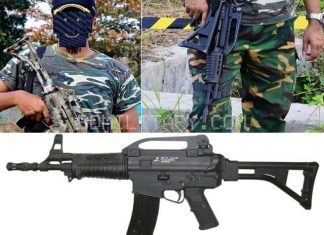
On foot, Soewarno moved toward Mount Muntaha. In a small forest at the foot of the mountain, about 40 Kopaska soldiers in civilian clothes and armed with Thompson automatic rifles were already waiting. These frogmen had previously traveled their own separate ways and with different covers to reach Mount Muntaha in Johor Bahru. Each man was allotted 500 rounds of ammunition and 10 kilograms of explosives. The plan was that after carrying out the mission they would return to Batam Island. After praying, the 40 Kopaska men dispersed at once and Soewarno was left at that location.
Before he could act, suddenly a platoon of Federal police equipped with heavy weapons surrounded him. Feeling that resistance was futile, Soewarno immediately raised his hands. He only then realized that the contact he was supposed to meet in Johor Bahru had been playing ‘both sides’ (a double agent).
Soewarno was interrogated and beaten mercilessly. The interrogators pressed him with questions, “Who are you? What are you doing in the forest? Who is your contact here?” These questions were repeated over and over while all kinds of physical torture landed on his body.
When the police telephoned him, Soen Gwan, who was a local asset cultivated by the BPI, hurried to visit Soewarno in the Kota Tinggi police detention. With great difficulty the businessman finally managed to secure Soewarno’s release for 500 US dollars. As they were about to leave, Soewarno and Soen Gwan happened to cross paths with Prijatna, who had also been arrested. The sharp-eyed Federal police immediately probed with a question, whether Prijatna knew Soewarno. Unfortunately Prijatna, who had apparently just been tortured, slipped up and admitted that he knew ‘Junus bin Usman’.
At once both were led back into their cells. Soen Gwan’s attempt to secure Soewarno’s release again was in vain. Soewarno and Prijatna were placed in two separate cells. When it was quiet, Soewarno cursed Prijatna furiously, regardless of his higher rank. The reason was that because of Prijatna he had to sit in a cell again.
Meanwhile, in Sekupang word spread that Soewarno and Prijatna had failed to carry out their mission and that the two frogmen were therefore considered dead. Because their mission was secret in a war that was never declared (an undeclared war), they could not possibly hope to be treated like prisoners of war (POW) entitled to treatment under the Geneva Convention. Far from adequate facilities, all they swallowed every day was torture after torture without end. They also suffered humiliation. It ranged from being stripped naked to being made to sit on a rattan chair with both hands tied to their left thighs. Their status was equated with criminals, not prisoners of war. Apparently their identity as Kopaska soldiers was not exposed.
Two days later, they were sent to the Federal secret service branch office in Johor Bahru. The escort of the prison van carrying them was very light. When passing a high bridge over a river, Soewarno even thought of escaping by jumping into the river. But the idea was abandoned when he saw Prijatna’s condition, exhausted after losing a lot of blood. He would certainly not have survived.
Upon arriving at their destination, they were again served a menu of interrogations. They ranged from gentle ones full of trickery to ones full of torture. After nine days of being tortured continuously without being given even the slightest chance to close their eyes, Soewarno was brought before a court. Fortunately the charge was light, only that of smuggling natural commodities. The sentence was three months in prison, which in practice he served for only two months because it was cut for his good behavior in prison, under local law.
At the beginning of 1964, Soewarno was finally free from prison and could breathe free air. After going through a return journey no less winding, the Kopaska soldier, who ended his service in the Indonesian Navy with the rank of first assistant lieutenant (peltu), was able to return to his base on Sekupang Island.
Later, Soewarno only learned that actually, a day before he was captured, there had been a special envoy from Bung Karno, a Brimob member, carrying the order to cancel the mission. Apparently the news could not reach the field because the courier had difficulty meeting the frogmen carrying out the mission.