The Story of China’s SA-2 Guideline Anti-Aircraft Missile – HobbyMiliter.com – Since the Kuomintang (the Nationalists) were driven from mainland China to the island of Taiwan (which then became the RoC, Republic of China, to this day) after their defeat by the communist army (which then became the PRC, People’s Republic of China) in the Chinese civil war (1946–1948), Western intelligence capability (especially America’s) to monitor developments in mainland China fell drastically.
This was a major setback, considering that at the time China was still one of the Soviet Union’s closest allies, so it was very important for the West to know everything that was happening there.
Peering into the Dragon’s Lair

Given the situation, deploying reconnaissance aircraft was the main option, and sometimes even the only option, to tap information from mainland China. And in the end, the airspace above the PRC was often visited by uninvited guests, from RAF Spitfires to bombers modified as reconnaissance aircraft, the Martin RB-57D, flown by the Taiwanese Air Force.

In the CIA’s “Diamond Lil” program, starting in 1958 a number of Taiwanese Air Force pilots were trained by America to operate the RB-57, and were then “given” 3 RB-57 aircraft. As a result, from 1959 they began flying reconnaissance missions deep over the PRC. And because they were ordered to fly high, at least 20,000 meters or more, PRC fighters could not reach and intercept them, let alone its anti-aircraft artillery. But the happy times did not last forever, and the communists began looking for ways to deal with these secret flights.
Uncle SAM Comes to China

It was crystal clear that for the PRC, Taiwan’s secret flights were unacceptable, but at the time the PRC also had nothing that could counter those secret flights. For this reason, the PRC leader asked the Soviet Union for help. The Soviets responded well, and from late 1958 to early 1959 several batteries of the SA-75 Dvina (SA-2) air defense missile system began to be bought by China. At the time, relations between China and the Soviet Union had not yet soured.
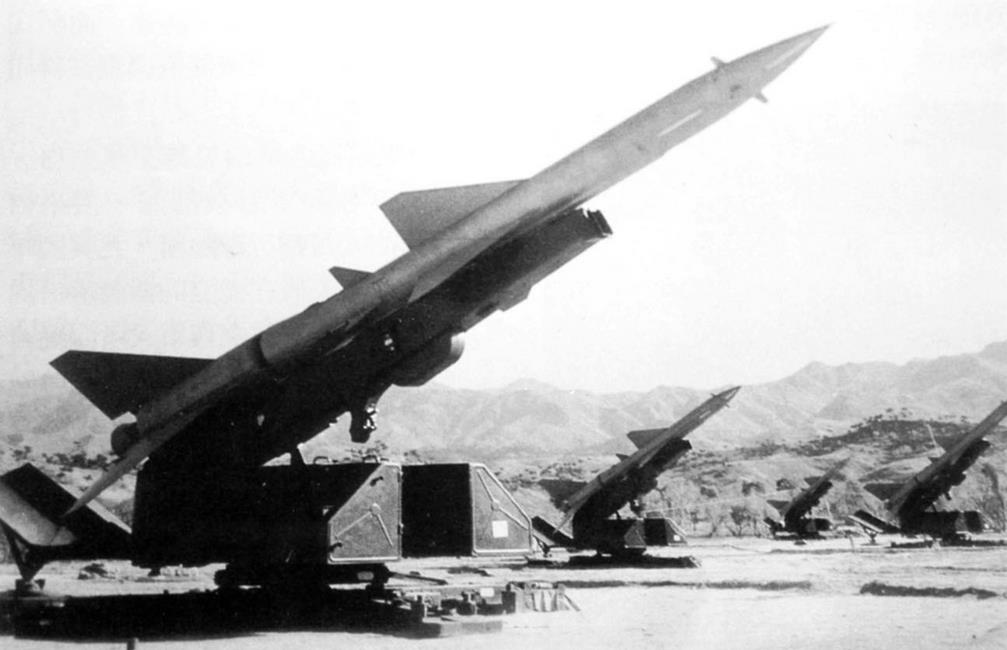
In total, the first delivery consisted of 5 SA-2 batteries and 1 training set bought by the PRC, together with 62 V-750 and V-750V missiles. Along with this delivery came advisers and instructors from the Soviet Union, headed by Colonel Victor Slusar, to assemble the new weapon system and train PLAAF personnel to operate it.
The Soviet advisers and instructors noted that the students from China were extremely enthusiastic learners and able to absorb all knowledge quickly and thoroughly. As a result, in mid-June 1959 the first team operating the SA-75 anti-aircraft missile system successfully carried out its first live firing test in the Gobi Desert.
Even so, a further 2 months of very intensive training were still needed before the students manning this new weapon system were judged capable enough to use it. Despite the many technical problems that usually accompany the implementation of a new system, the PRC’s first SAM battery was declared operational in August 1959. Uncle “SAM” had come to China!

After a month of operational trials, on 20 September 1959 the PLAAF anti-aircraft missile unit was finally declared combat ready and began to be deployed around Beijing. Around that time, and even before, Taiwan’s secret flights continued, and in June 1959 a Taiwanese RB-57 flew a reconnaissance mission over the PRC capital, Beijing (Peking at the time).
The few SAM batteries newly available were positioned around Beijing in such a way as to cover the flight routes expected to be used by the Taiwanese reconnaissance aircraft that had passed over Beijing several times.
To preserve the strategic value of this SAM system, its deployment was carried out in complete secrecy. The crew and personnel of the unit were disguised as an oil drilling crew searching for oil resources, a disguise considered perfect because with that status, the movement and relocation of “various pieces of technical equipment” would not easily arouse suspicion.
It should also be noted that at the time, the entire crew of the anti-aircraft missile system unit was 100 percent PLAAF, with no Soviet instructors involved in operations. The status of the Soviet crew in the operational unit was only as advisers.
A Test of Patience

The operators of the newly graduated PLAAF SA-2 Guideline/S-75 Dvina anti-aircraft missile were itching to prove the results of their training, but as it happened, 2 weeks had passed since combat readiness and nothing had happened. Not a single RoCAF aircraft had crossed over. Tension began to be felt from 1 to 4 October 1959, during the 10th anniversary of the PRC Declaration. It was hoped and expected that an enemy spy plane would cross over, but after those dates had passed, not a single “uninvited guest” had come.
Suddenly, on the morning of 5 October, an aircraft was detected flying from Taiwan and entering PRC airspace in Fujian province. PRC radar began tracking the secret flight heading toward Nanking. PLAAF fighter aircraft were scrambled, but because the target aircraft was flying at an altitude above 20,000 meters, PLAAF fighters were practically only able to shadow it from far below at low altitude and could not intercept the target.

Meanwhile the target kept moving until it crossed the Yangtze River and was 500 km from Beijing. The anti-aircraft missile system began to be prepared and the operators began to think that this was the moment to prove the intensive training they had undergone. But suddenly the target turned toward Shanghai and flew away from Beijing without ever entering the firing range of the PLAAF’s new SAM system.
The government and the PLAAF were of course disappointed at not yet being able to prove the reliability of the new SAM system. But above all, they worried that somehow the existence of the SAM and their deployment positions had leaked to the enemy. However, after various considerations, they decided to make no changes and wait for another opportunity to shoot down an enemy secret flight aircraft. A good and correct decision.
A Direct Hit!!
Two days later, on 7 October 1959, an almost identical event occurred. PLAAF radar operators detected a high-flying intruder. Because of the clear importance of dealing with this secret flight, everything was coordinated by the PLA Chief of Staff, and the presence of Colonel Slusar was important given his role as adviser.
Although based on experience so far PLAAF fighter aircraft were unable to intercept intruders flying at altitudes above 20,000 meters, they were still ordered to scramble and shadow the target. The hope was that the target would (hopefully) develop a problem and be forced to lose altitude so it could be intercepted by the fighter aircraft standing by in pursuit.
Meanwhile, from visual contact, the secret flight was identified as RB-57D number 5643. The aircraft was flown by Captain Ying Chin Wong and was flying straight toward Beijing, and this time it did not turn back as it had 2 days before. It soon became clear that the RB-57D would soon enter the firing range of the SAM system newly installed around Beijing. And for this reason all the fighter aircraft shadowing it were ordered to disengage and leave the target, clearing the way for the new missile to prove itself.
The RB-57D flew toward the firing range of the SA-2 Guideline/S-75 Dvina SAM system of the 2nd Rocket (i.e. missile) Battalion under the command of Yue Zhenhua. While the target was still 200 km away, he received the order to destroy the target. The battalion’s radar detected the target at a distance of 115 km, and the distance kept shrinking as the RB-57 flew toward Beijing. And when the target was 41 km away, Yue Zhenhua gave the order to fire 3 missiles at once in a salvo. The first missile was recorded as fired at 12:04 local time and was immediately followed by the remaining 2 missiles.
About 40+ seconds later the anti-aircraft missile struck the target at a distance of 29–30 km. For Yue Zhenhua there was no doubt that his target had been hit squarely, because on the radar the target began to lose altitude rapidly. At an altitude of 5,000 meters, the target disappeared from the radar screen and it was concluded that the target had broken up in the air. The success of this interception was immediately reported up the chain of command, and a PLA general accompanied by Col. Slusar immediately inspected the crash site of the RB-57 by helicopter. Because it had been plotted by radar earlier, the crash site could be found easily.
The wreckage was scattered within a radius of 5–6 km. And although it had shattered into pieces, the wreckage could still be recognized as an RB-57. After examination, a total of 2,471 holes caused by shrapnel from the V-705 missile were found in the fuselage of the wreckage. So it is no wonder the aircraft shattered into pieces. And the missile fragments also killed the pilot of the aircraft. That was the first time an anti-aircraft missile / SAM had succeeded in shooting down its target in anger.
Translator notes:
– The source names the missiles V-750 and V-750V earlier in the article, then writes V-705 here. Translated as written.