

MiG-29 vs F-16, Which Fighter Jet Is Superior? – HobbyMiliter.com – The question of which is superior, Western technology or Eastern technology, has long been a fierce debate between the diehard fanatical supporters of both camps. This comparison topic is often discussed in various military forums, Facebook groups and fan pages, and even in conversations in front of coffee stalls. But on average, in discussions among diehard fans, the opinions given will be biased. Especially if they run into a figure named Trisna Istrinya Dua (#ehh).
But what is interesting is that, with the fall of the Soviet Union and the dissolution of the Warsaw Pact, there are now several countries that possess both Western bloc technology and Eastern bloc technology at the same time. Among them are NATO countries whose air forces fly MiG and Sukhoi aircraft.
Even the USAF itself managed to buy a number of MiG-29s from Moldova and leased ex-Ukrainian Sukhoi Su-27s from a private company to be used as test material and to train its pilots to fight against “real” enemy aircraft that fly with the actual performance and doctrine of the “enemy”. This situation makes it possible for comparison tests to be carried out within a scientific research framework, although of course not all test results can be published.
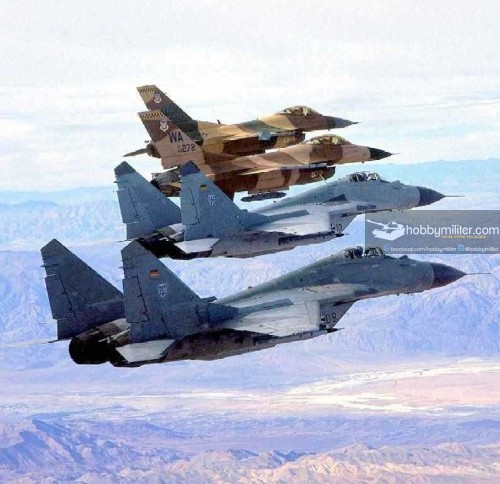
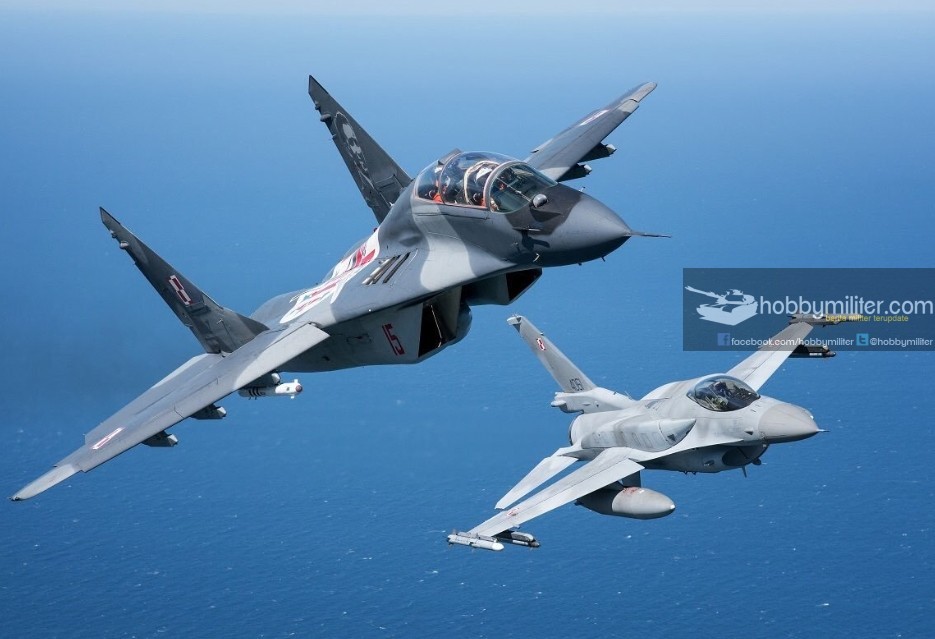
The Polish Air Force, which is a NATO member, currently operates F-16 fighters as well as MiG-29s (and also the Sukhoi Su-22), including 24 MiG-29s that Poland bought from Germany at the very cheap price of 1 Euro per aircraft.
It is very interesting to know the opinions of pilots from an air force with a mixed fleet like this. Usually, pilots identify themselves with the fighter jet they ride. MiG-29 pilots will tell of the advantages of the MiG-29 and F-16 pilots will also recount the strengths of the F-16. And all of it is true!
The MiG-29 and the F-16 are different fighter jets, made with different missions and doctrines. So how do we compare the two? Before comparing them, we must understand that the F-16 and the MiG-29 were developed under different conditions by two different countries. That will certainly have an impact on the differences in the capability requirements that each manufacturing country placed on the two fighter jets.
The F-16 was designed by America with the idea of a cheap and economical fighter, alias cost effective, a light fighter with multirole capability as a fighter as well as a bomber that could support the operations of the far, far more expensive F-15. In the era before the F-16, America adhered to a separation of roles between pure fighters and bomber-attackers. For example, between the F-4 Phantom II and the A-4 Skyhawk. That made operations expensive.
On the other hand, the Soviets designed the MiG-29 as a pure air superiority fighter. The designers of the MiG-29 set aside range and avionics in the making of the MiG-29. Instead, they prioritized having a powerful engine, the ability to fly at high altitude, having a good rate of climb, speed, and being able to take off from makeshift runways at the front line. Its opponent was the enemy fighter jet trying to attack its way in.
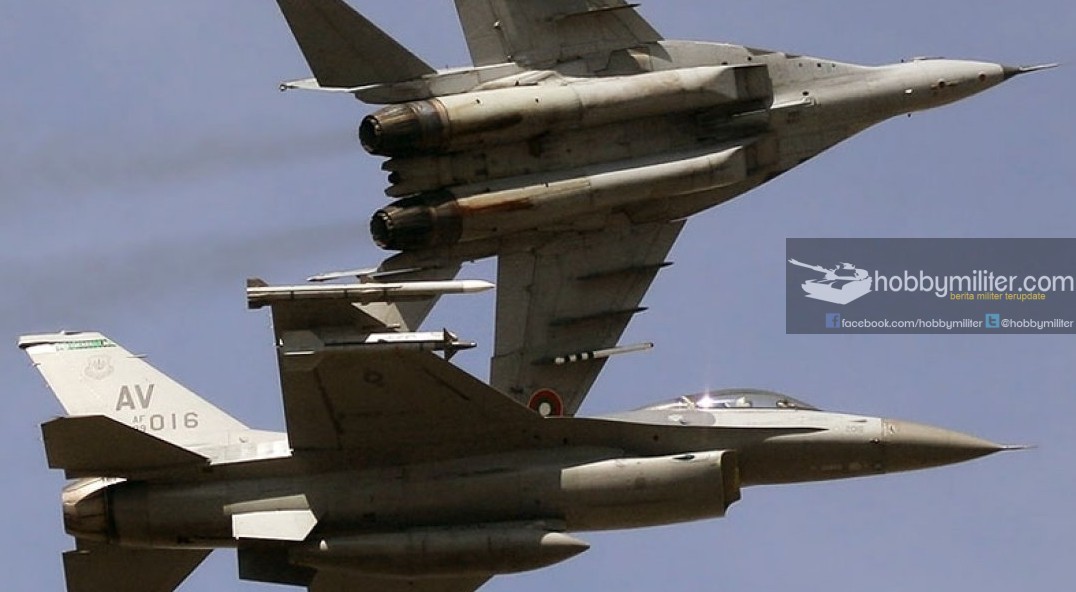
This difference in design concept is clearly reflected in the external construction of the two war machines. The MiG-29 Fulcrum has 2 Klimov RD-33 turbofan engines equipped with afterburners, so that it is more powerful, has a good rate of climb, and also for safety purposes, so that if 1 engine dies, it can still fly with the other engine.
This is to compensate for the endurance of Soviet-built engines, which also had a maintenance doctrine that differed from Western engines. The airframe of the MiG-29 is very rigid, and its air intakes are equipped with doors to prevent FOD from entering the engine when landing on a poor runway. Although in later days this feature was removed by Russia in the making of the final versions of the MiG-29, including on the MiG-35.
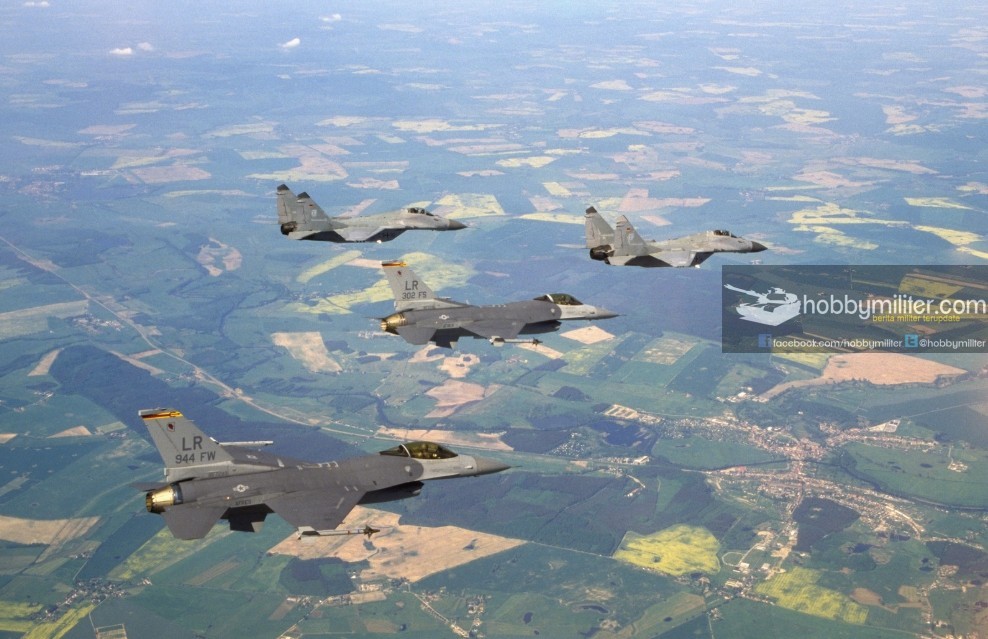 The designers of the F-16, in contrast, felt confident in equipping this fighter jet with only 1 engine. Besides being cheaper (as the main goal of designing this aircraft as a low cost fighter), it also pursued maintenance efficiency and suppressed operational costs in line with the initial concept of this aircraft as a cheap and cost effective light fighter.
The designers of the F-16 also felt the need to make improvements to the cockpit and ergonomics for the comfort and effectiveness of the pilot. Because of that, the F-16 has a frameless bubble canopy design (bubble canopy) that provides a wide and unlimited view. A happy pilot is an effective pilot.
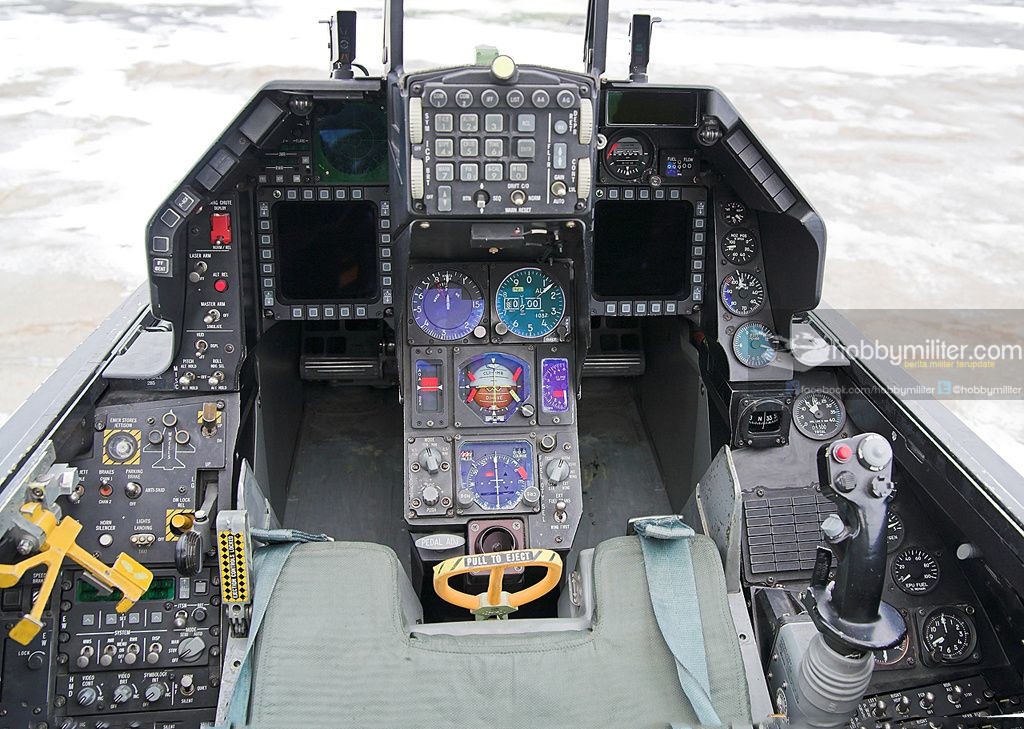
In addition, the pilot’s seat is also reclined backward by 30 degrees, not upright like other fighter jets. The control stick, which on other fighter jets is usually located between the two legs, was moved to the right side of the pilot, where a gentle touch is already enough to control the aircraft. So, controlling the F-16 is just like playing an arcade game. In addition, the F-16 is also equipped with various multifunctional displays and various kinds of flight automation, which of course increase the combat capability of its pilot.
Nevertheless, we will try to compare the MiG-29A Fulcrum with the F-16C Fighting Falcon. Why choose these two versions? This is because the MiG-29A Fulcrum is an aircraft that entered operational service in the mid-1980s, at the same time as the C version of the F-16. Remember, the F-16A is 1970s technology. So it can be said that, in terms of operational era, the MiG-29A and the F-16C are contemporaries.
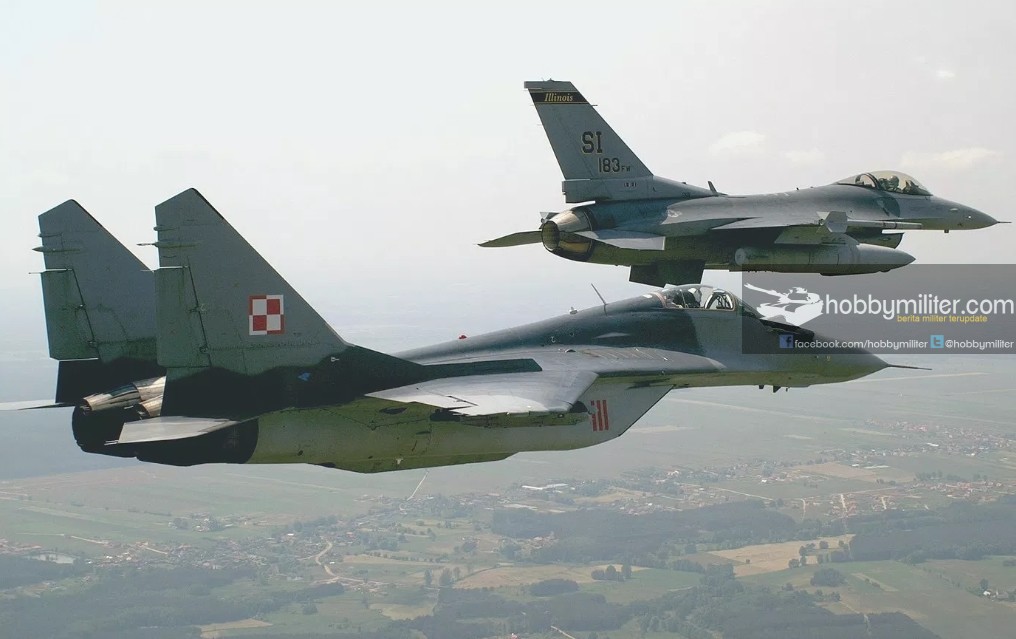
If they meet in battle, the two fighter jets cannot attack each other from a very long distance (above 100 km). If each flies head-on toward the other, there is a possibility that the MiG-29 will be detected by the F-16’s radar first. This is because the F-16C has a better radar with all weather and BVR capability.
Meanwhile, it is not that the MiG-29’s radar is worse, but rather because it was designed with the thinking that the MiG-29 fighter does not need to be burdened with a large radar so that it is more agile, in connection with its role as an air superiority fighter. Because in its operations it would anyway be guided and controlled by GCI radar officers (Ground-controlled interception, ground radar officers whose duty is to guide fighter jets).
This difference in design concept gives the F-16 pilot more reaction time if the MiG-29 is outside the coverage of its GCI radar assistance. Conversely, if the F-16 is inside the opponent’s GCI radar coverage area, the MiG-29 could carry out an ambush strategy first with GCI guidance.
If each fires its missiles, it is very difficult to predict the result because the technical data of the R-27R (AA-10 Alamo) is not accurate. Russian sources state that the range of this missile can reach 100 km. If that is true, then at that distance of 100 km it is not clear whether the MiG-29’s radar is still able to guide the semi-active-radar-homing missile precisely to the target. The effective range of the missile is determined by the capability of the radar on the aircraft, because the missile needs target data from the aircraft’s radar. Understandably, its seeker is of the semi-active-radar-homing type.
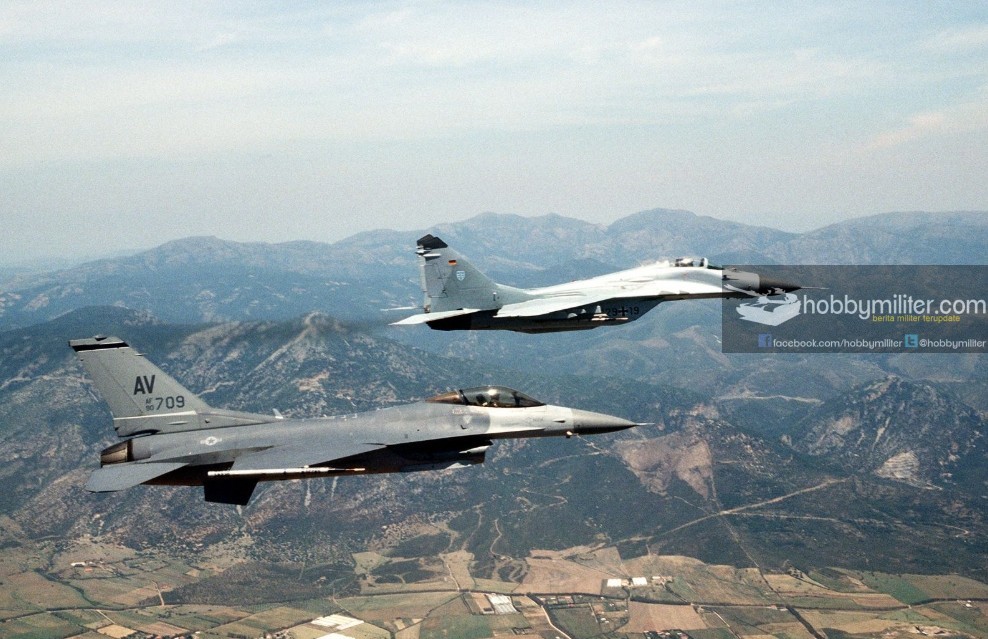
Conversely, the F-16 with its AMRAAM missiles might actually have more of an advantage. AMRAAM is a missile with an active radar homing guidance system. That way the pilot can fire the missile, then immediately maneuver to evade, without having to keep pointing the nose of the aircraft toward the target like the MiG-29. Fire and Forget.
If both missiles fail to find their targets and both aircraft must engage in a dogfight at visual distance, the advantage of the MiG-29 will be more apparent. The MiG-29 has superior maneuvering capability, alias it is more maneuverable, the thing that makes the appearances of the MiG-29 (and the Sukhoi Su-27) always impressive in airshow performances.
With a Helmet Mounted Sight, the MiG-29 pilot can fire a short-range missile without having to be behind the opponent’s aircraft. Simply by turning his head toward the opponent’s aircraft, the IR sensor will lock onto the opponent’s aircraft, whereas the F-16, even when equipped with all aspect Sidewinders, still has to place the nose of the aircraft toward the target first to lock it.
But once again it must be emphasized, we are comparing the F-16C with the MiG-29A. Of course, many improvements have already been made to the final versions of both aircraft, for example between the F-16 Block 70 and the MiG-35.
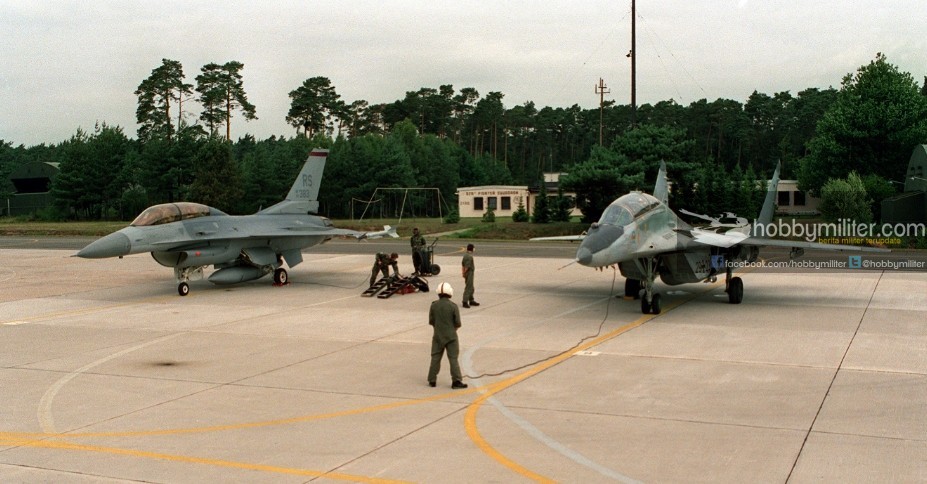
If the missiles have run out but both still survive, then it is time for the cannons to speak. The F-16 has the M61 Vulcan cannon with a higher rate-of-fire, around 6,000 rounds per minute. Meanwhile, the MiG-29 has the GSh-30-1 cannon with a rate-of-fire of only around 1,500 rounds per minute, but it has a caliber of 30 mm, larger than the 20 mm caliber of the M61 Vulcan. This means that, if it hits, MiG-29 rounds have greater destructive power compared to F-16 rounds.
In addition, the laser rangefinder of the MiG-29’s GSh-30-1 cannon is very accurate, so that in simulations, only 3 to 5 rounds are already enough to destroy the opponent. In addition, the MiG-29 (and its life partner, the Su-27) is also equipped with IRST (Infra-red search and track).
From here it can already be seen that the F-16 has an advantage at medium distance while the MiG-29 has an advantage at visual distance. But even so, the result of a combat mission still depends on many factors. Among others, the weapons carried and the ability and experience of the pilot himself. The ability and experience of a pilot are based on how often the pilot trains, and on the quality of the pilot’s training itself.
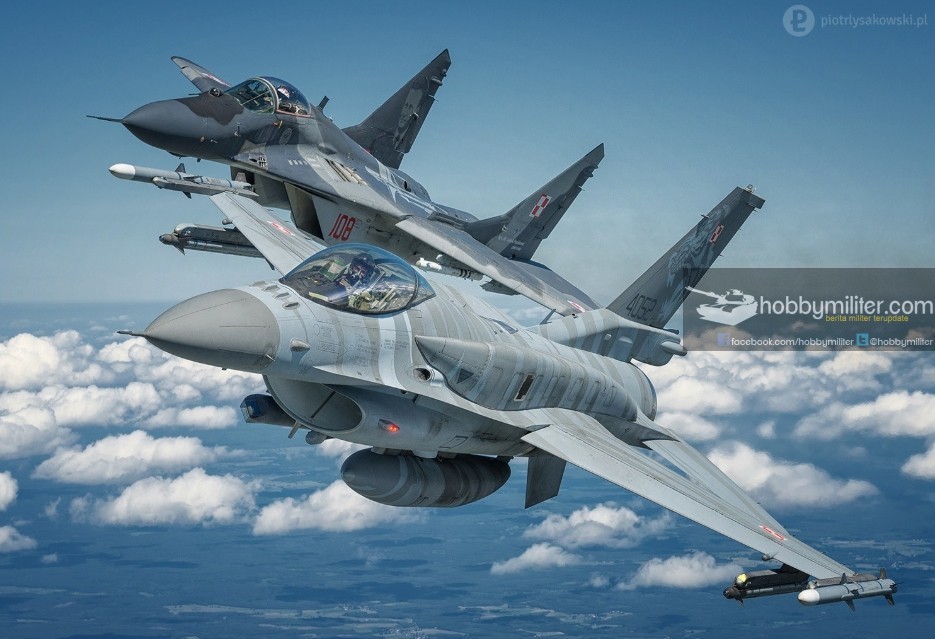
In addition, an air force that has fought in a real war certainly has important know-how that is not possessed by those who have never been involved in real combat, let alone those who have never fought for real and also never train with other parties or train against other types of aircraft.
From the side of real combat, the F-16 has a Kill/Loss ratio of 92:13. Meanwhile, the MiG-29 has a Kill/Loss ratio of 16:28. The F-16’s victims were delivered the most by the Israeli Air Force with 52 confirmed kills, and second place was delivered by the Pakistan Air Force with 24 confirmed kills.
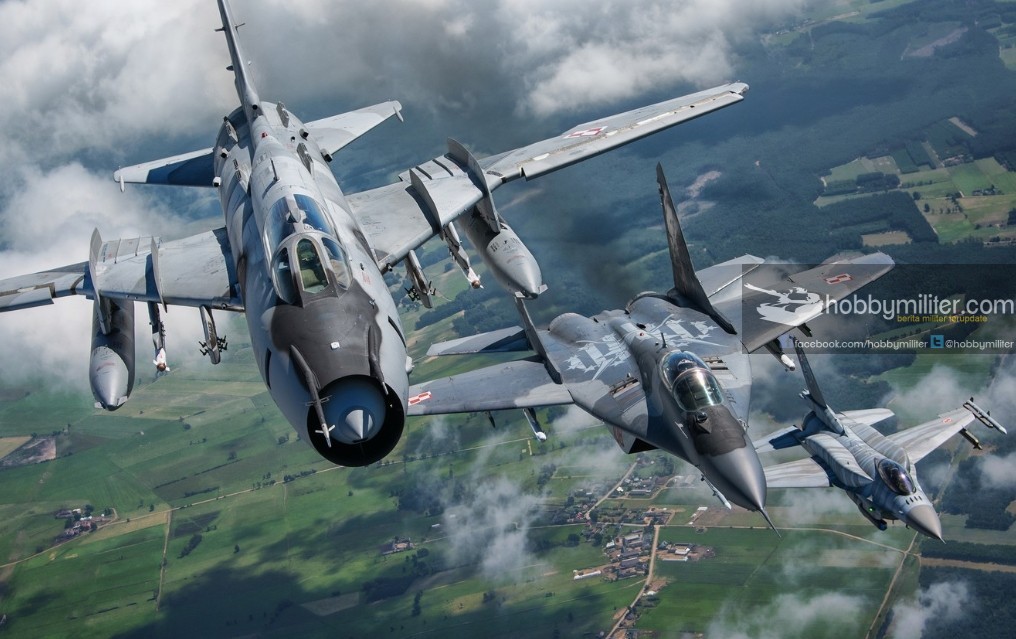
Third place is the Turkish Air Force. As mentioned above, each incident may have many different reasons and circumstances, and it does not mean the F-16 has far better capability.
It is very difficult to determine which fighter jet is the best in this MiG-29 vs F-16 case. There are various crucial differences between the MiG-29 and the F-16 that cannot be mentioned in detail in this article. But of course, with all their advantages and disadvantages, both are great fighter jets.
In some opinions, older German pilots prefer to fly the MiG-29 because they can “feel” its control in the control stick, compared to the controls of the F-16, which are said to resemble “video game controls”. Understandably, the F-16 uses computer-based Fly-by-Wire technology, while the MiG-29 uses hydraulic controls.
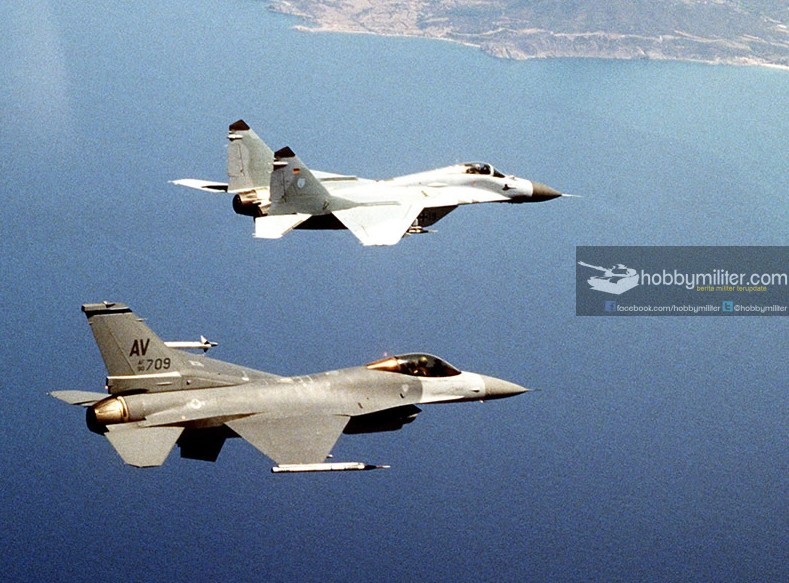
By the way, we can, you know, fly as a passenger in a MiG-29 by paying a certain amount in a tourist attraction in Russia, something that the F-16 does not provide. This may be the MiG-29’s victory in this epic MiG-29 vs F-16 saga.