Operation Gift – HobbyMiliter.com – Anyone knows the Middle East is destined to be a “hot” region. Almost every day there is a seed of conflict flaring up. It happens not only in relations between countries there, but sometimes it also arises among factions within an organization. Israel’s anger in 1968 in this story, as written in The Elite by Samuel M. Katz (1992), is an example of how vulnerable such relations are there.
That incident was precisely triggered by another case, the hijacking of an El Al aircraft that occurred on 22 July 1968. Three members of a hardline group based in the Middle East suddenly brandished weapons inside the cabin of the Israeli airline’s aircraft shortly after taking off from Fiumicino Airport, Rome, Italy. This action shocked Israel because it was the first time it had happened to them. The terror on the flight to Lod Airport (now Ben Gurion Airport), Tel Aviv, Israel, had a long aftermath.
After killing the pilot, the hijackers, one of whom was a former Gulf Air pilot, diverted the aircraft carrying 39 people to Dar El Baida Airport, Algeria. Almost all the passengers were freed except eight Israeli men who were handed over to Algerian intelligence for interrogation. The organization intended to use the hostages as a bargaining commodity for its members detained by the Israeli authorities.
While Israel was still confused about determining the most effective way to resolve a case like this, they struck again against another El Al aircraft, but in a different way and location. Four months later (26/11/68), an El Al aircraft about to take off from Athens Airport (Greece) was suddenly shot at and pelted with grenades.
The aircraft caught fire, an El Al technician was killed, a flight attendant was seriously injured, and a number of passengers suffered minor injuries. The perpetrators could be arrested, but the Greek side was forced to release them a few months later after its own aircraft was also “tampered with”. The perpetrator managed to hide his past and obtain Canadian citizenship, before finally being extradited by Canada in 2013 to Lebanon.
Israel actually had planned to launch a commando operation to free its citizens who were being held in the first hijacking in Algeria. But because the risk was too great, the operation codenamed Operation Gift (Mivtza Tshura) was forced to be cancelled. The plan then shifted to a retaliatory hijacking of a number of aircraft belonging to the airlines of the countries supporting the organization, which happened to be at Beirut International Airport, Lebanon.
The top brass of the Israeli Armed Forces considered the chance of success of this operation to be high, because besides being closer in distance, its economic value was also higher. Israel wanted to “use” those aircraft as bargaining capital with the hijackers.

Before the plan was even mature, the Athens incident happened. Israel was furious. After various considerations, it was finally decided that the objective of the raid on Beirut Airport was not only to seize. Operation Gift was also staged to destroy as many aircraft as possible in the shortest possible time. The operation took the form of an airborne assault by commando forces and not a bombing action by the Israeli fighter jet fleet.
Israeli Special Forces Sayeret Matkal
Long before the Rome incident, the Israeli intelligence service, Mossad, had gathered a lot of data on the situation at airports in several Arab capitals, including Beirut. Almost no daily airport activity escaped their observation. The international airport located in the southern part of the metropolitan city of Beirut is only two kilometers from the Mediterranean coast. About 90 kilometers south of the airport lies the northernmost Israel-Lebanon border town, Rosh Hanikra.
The two runways of Beirut Airport cross each other, forming a scissor formation stretching from north to south. Between the two ends on the western side there is a hangar for repairing aircraft that are undergoing maintenance. The headquarters of the local fire brigade (PMK) and paramedic unit deployed whenever an aircraft accident occurs is south of the passenger terminal.
Security of the airport complex was carried out by 90 lightly armed security guards divided into three shift groups. If needed, about three kilometers from the airport there is the headquarters of a Lebanese Army platoon with a strength of 28 men that can be readied within five minutes. The elite police unit headquartered in the city center can reach the airport in less than half an hour.
The Lebanese Army armored unit could also be asked to support. They need about one hour to reach the airport. Mossad also knew that near the airport there were several refugee camps that were often used as recruitment bases for the perpetrators of attacks in the South Lebanon region.
In a series of cabinet meetings led by PM Levi Eshkol, there was debate about which unit would be entrusted with carrying out the operation. Finally, agreement was reached that this “show of force” task would be placed on the shoulders of the Combat Reconnaissance Battalion of the Israeli Armed Forces Headquarters, Sayeret Matkal. And the operation was carried out two days after the incident in Athens.
Within the Israeli Armed Forces, Sayeret Matkal is regarded as the most reliable elite unit. Its strength is less than 200 men, but its experience in a number of combat intelligence and commando actions between 1963 and 1968 is a special guarantee. As is usual for Israeli elites, the existence of this red beret is kept highly secret.
Not many cabinet ministers or top Israeli Armed Forces officers knew its ins and outs. This was what made Defense Minister Moshe Dayan and Armed Forces Commander Lt. Gen. Chaim Bar Lev uneasy. Whatever the outcome of this operation, its impact would certainly be very wide and sensational. The identity and activities of Sayeret Matkal would be exposed.
So that its existence would remain hidden, it was decided that the Reconnaissance Unit of the 35th Infantry Brigade of the Army (Sayeret Tzanhanim) would also be involved to accompany Matkal. The Paratroop Commander, Brig. Gen. Rafael “Raful” Eitan, was entrusted to lead the operation with Col. Chaim Nadel as his deputy.
In staging this operation, PM Levi Eshkol only asked that the number of casualties, especially among local and foreign civilians, be kept as small as possible. This was stressed so that Israel’s image would not be battered by being branded as a brainless executioner.
In the operation plan, Brig. Gen. Eitan divided Beirut Airport into three sectors, namely west, east, and the passenger terminal. Unit 1, with 22 Sayeret Matkal personnel led by its own commander, Lt. Col. Uzi Yairi, would be assigned to destroy aircraft in the western area. Unit 2, with 20 personnel led by Matkal Deputy Commander Maj. Menachem Digli, was given the task of pulverizing aircraft still in the western area.
If there was a sudden attack, this unit was the one that had to suppress it. Likewise, in the air evacuation process, this unit had to form a defensive perimeter. Meanwhile, Unit 3, with 22 members of B Company, Tzanhanim, led by Capt. Gabi Negbi, was assigned to blow up the aircraft stretching from the northern side of the eastern runway, the south of the airport, to the departure terminal.
Each unit was equipped with packages of explosives. All of them were carried to the targets by air. So that every step of the operation could be coordinated, an advance commando group of 12 men led directly by Brig. Gen. Eitan was formed.
There were three options for how to evacuate all members of the force at the end of the mission. First, all would be evacuated from the intersection point of the two runways, codenamed point “London”, and carried by several Super Frelon helicopters that had originally been used to arrive at the location. Second, if a Super Frelon helicopter was damaged or destroyed, two Nord Noratlas transport aircraft would land on one of the runways and carry all members of the force.

Third, if an emergency occurred beyond the original calculation, the last resort to be taken was to travel by land to the meeting point on the Beirut beach, codenamed “Roma” beach, and then be evacuated by sea under the escort of the Navy commando unit.
Joint Operation of Three Services
Operation Gift meant a great deal to the Israeli Armed Forces. That is why the Air Force and Navy also supported the operation. The Israeli Air Force (Heyl Ha’Avir) provided eight French-made SA-341K Super Frelon helicopters as the main transport. Two of them were reserves.
The commander of the Air Force helicopter squadron, Lt. Col. Eliezer “Cheetah” Cohen, also fielded eight US-made Bell 205 helicopters modified to be armed (one of them as a reserve). Five units to secure the evacuation process (if the Super Frelon fleet was attacked). One unit would be made into an advance command post where Brig. Gen. Eitan was based. And one more to carry communications transmission equipment.
Lt. Col. Cohen would be in one of the Bell 205s accompanied by a paratroop officer, an air mechanic, and paramedic personnel. Together with another Bell 205, Lt. Col. Cohen also got the task of blockading the roads to the northern and eastern areas of the airport to prevent the arrival of Lebanese Army reinforcements.
Besides the Super Frelon and Bell 205, the Israeli Air Force also deployed five N-2501-IS Nord Noratlas transport aircraft (one of them as a reserve) that would circle over Beirut. Two Nord Noratlas were tasked with scattering smoke grenades in the residential areas around the airport while carrying communications transmission equipment.
So that Brig. Gen. Eitan could communicate with Gen. Dayan at all times, two Boeing 707s filled with sophisticated telecommunications equipment stood by over the Lebanese coast, escorted by a fleet of two fighter aircraft consisting of two A-4 Skyhawks, four Vautour IIIs, and half a dozen Mirage IIICs.
The Air Force wanted to be on guard in case a sudden attack came from the Lebanese or Syrian Air Force. At this time, Israel did not yet have sophisticated American-made fighter aircraft because it had only just been freed from the military embargo imposed by America since 1948, almost 20 years earlier.
Not wanting to be left behind, the Navy (Heyl Ha’Yam) would deploy two Sa’ar-class patrol boats equipped with Gabriel guided missiles and 13 Zodiac rubber boats plus one platoon of Navy commando forces. After a non-stop 3.5-hour voyage, this Navy commando task group would stand by somewhere between Tyre and Sidon, about six nautical miles from “Roma” beach, right at “H” hour when the operation on land was carried out. The two patrol boats would anchor about 12 nautical miles off the Beirut coast because they were beyond the range of Lebanese radar. (In practice, only one ship went into action because the other’s engine broke down).
In the final consolidation meeting attended by all members of the executing force, it was again stressed that the targets were only aircraft from the countries supporting the organization. Other aircraft were not to be touched at all so as not to provoke international condemnation.
Each aircraft would be destroyed by placing two explosive packages on the landing gear. One under the nose while the other on one of the wings. The explosion was expected to disable and burn the aircraft. Although each aircraft would be blown up separately, a chain of explosive packages with a single detonator button could also be used to destroy several aircraft at once.
The force members were free to choose the method of detonation depending on the situation and conditions in the field. The operation was estimated to take about 30 minutes, counted from the first Super Frelon helicopter landing until the last helicopter left the location.

“H” Day was set for Saturday, 28 December 1968. “J” Hour was originally planned for the night at 22.00 Beirut time, and then it was proposed to be moved 45 minutes earlier. The reason was that around that time there were far more aircraft at the airport than at 22.00. So it was hoped the result would be more optimal.
Without much questioning, the Israeli PM immediately approved the execution of this operation after Lt. Gen. Bar Lev explained in detail the steps to be taken, armed with a wealth of data presented in aerial photographs of the targets.
Operation Gift’s Main Target: Beirut Airport, Lebanon
Approaching “H” Day, Lt. Gen. Bar Lev was forced to reject the Air Force’s proposal to conduct aerial photography to obtain the latest data on the target situation. He worried the Lebanese side would become suspicious, causing the element of surprise to be lost. As a result of that choice, Brig. Gen. Eitan and his men were forced to rely on data collected a month earlier.
So that his men would not hit the wrong target, besides requiring the entire force to memorize them, Brig. Gen. Eitan also equipped his men with small cards picturing a number of logos of the targeted airlines. Eitan reasoned that in a tense and chaotic situation due to being chased by a tight schedule, his men could make a “mistake” with fatal consequences for his country. As much as possible, this had to be prevented.
The operation rehearsal was carried out on “H” Day from morning to evening without stopping, at Lod Airport, which is now called Ben Gurion. Many parties opposed this choice of location because they worried the secret of Operation Gift would leak to the public before its time. But Brig. Gen. Eitan remained firm in his choice. He reasoned this method was more practical and could be disguised as a routine anti-terror training activity. After sweating for 10 hours, when the sun set, all members of the force were rested, with Brig. Gen. Eitan immediately reporting the readiness of his forces to Lt. Gen. Bar Lev.

At exactly 20.00, Brig. Gen. Eitan conducted the final inspection before departure. All members of the force were in full combat uniform with their red berets. They carried Soviet-made AK-47 assault rifles in 7.62 mm caliber and carried green backpacks full of fuel. The AK-47 was chosen because its effective firing range was better than the 9 mm caliber Uzi submachine gun.
But its shape was more compact than the standard rifle of the Israeli Armed Forces at the time, the Belgian-made FN FAL in 7.62 mm caliber. Plus, the opposing forces also used it, so if they had to be held up, they could use magazines and ammunition from the enemy.
Besides wishing them farewell, Brig. Gen. Eitan also said, “Always use your brain and take good care of yourselves. I do not want to sing Radish for you!” Radish is the song that accompanies the death ceremony of Jewish people.
The entire helicopter fleet began to move, leaving Ramat David Air Base in northern Israel at 20.37. The dark night atmosphere suddenly became noisy with the sound of engines and helicopter rotors. The flight from Ramat David to Beirut would take 45 minutes for the Super Frelon and 53 minutes for the Bell 205.
This convoy immediately cut across the conventional route through the Fazreel Valley and Zevulun Valley to consolidate for a moment at a point 12 km west of Rosh Hanikra. Then it immediately sped up to reach maximum flight altitude to avoid attracting the attention of residents along the travel route.
The helicopter procession then turned sharply to the northeast along the coastline to save fuel, although the risk was being caught by Lebanese Air Force radar. As they approached the airport area, glittering with the lights of Beirut, all the helicopters lowered their altitude to less than 100 m. As a result, the pilots’ view was blocked by winter fog from the Mediterranean Sea.

At exactly 21.28, the helicopters managed to drop the troops, and the three main executing units of the operation managed to set foot on the runway without being caught by the hosts. Thirty-two men immediately ran toward their respective targets and identified as many prospective victims as possible. Meanwhile, their protective forces immediately took up firing positions.
Five minutes later, Brig. Gen. Eitan’s helicopter arrived at the target location. Operation Gift began!
29 Minutes, 14 Aircraft Destroyed Without Losses on Our Side
As the unit that landed first, Unit 2 was the first to engage in armed contact with the Lebanese side. Although in an open field south of the airport, gunfire rang out from various sides, Unit 2 was able to silence it in a short time. While their comrades provided covering fire, the Unit 2 demolition squad hurried north across the building where the fire brigade unit was located toward its assigned target.
Under the bright light, four aircraft were seen parked there. Each got five kilograms of explosives. Without much difficulty, two aircraft were successfully blown up. When the third aircraft was about to be blown up, suddenly there was gunfire from the direction of the passenger terminal. But this attack could not save the aircraft. Next, one aircraft remained, which in the end was left untouched because its identity was unclear.
After carrying out the mission, Unit 2 immediately moved to point “London” in the middle of the airport. Hundreds of prospective passengers in the terminal were bewildered to see so many Israeli red beret troops running back and forth accompanied by flashes of AK-47 gunfire. Suddenly a startling roar was heard, accompanied by flames bursting into the air. Within seconds, the northern runway was lit by colorful tongues of flame soaring into the sky.
Lt. Col. Yairi, together with his men who landed in the northern area of the western runway, found 11 aircraft divided into three groups. Coincidentally, the location was near the Lebanese Army complex, whose lights were suddenly turned off when Unit 2 arrived.
A small squad of Lebanese soldiers riding in a minibus briefly put up resistance, but Yairi’s men were too strong for them. Of the three groups of aircraft, one consisted of five aircraft, while the other two each consisted of three aircraft. At this location, Unit 1 destroyed 10 aircraft, three of which were blown up simultaneously because they were located close to each other. The 11th aircraft was deliberately left alone because it was just a wrecked C-47.
Difficulty arose when three Middle East Airlines crew members stubbornly refused to leave their aircraft, which had been fitted with explosives. The three only gave in after being threatened with being shot on the spot. Because the place where they operated was not far from point “London”, although finished, Unit 1 did not move from its position. They only stood by waiting for the evacuation time.
Arriving at the designated point, Unit 3 immediately moved toward its share in the southern area along the eastern runway. There were four aircraft in total. One was inside the hangar, while the others were near the hangar door. At first, all four aircraft would be blown up together using a chain of explosive packages, but this intention was suddenly abandoned. There were dozens of workers in the hangar, whose lives would be threatened if the aircraft were blown up.

Several members of Unit 3 shouted in English and Arabic telling them to get out. But the workers panicked instead and crowded together into one room while locking the door. Capt. Negbi, who had run out of patience, immediately ordered the detonation to begin.
But for some reason, the explosion did not happen. The workers then cheered joyfully. Why? If the explosion had happened, hundreds of people at the airport, including the Israeli forces, would have been roasted alive because it turned out that one of the aircraft was a fuel tanker that had just been filled to the brim and would soon take off.
Unit 3 was finally withdrawn away from the hangar to the south. Capt. Negbi had asked Brig. Gen. Eitan for permission to blow up the petrol pump to the east behind the passenger terminal, but it was refused. Unit 3 was instead ordered to hurry to point “London”.
Not wanting to lose to their colleagues on the ground, Lt. Col. Cohen and his partner acted in the air. In two passes, they scattered 95 smoke grenades and 20 illumination grenades. As a result, artificial smoke fog occurred on all roads leading to the airport.
From the start, all parties involved realized this operation was indeed high risk. Whatever the basis, staying too long in enemy territory was clearly very risky. So Lt. Gen. Bar Lev decided all stages of the operation had to be completed within 30 minutes. The reality was that the time needed was only 29 minutes!
The unit that first arrived at the evacuation point was Unit 3. At exactly 21.47, carried by Super Frelon helicopters, they departed back to Israel. 10 minutes later, their comrades followed in succession back to the south, entering their homeland.
One Navy commando unit along with a dozen rubber boats that had originally been prepared at the beach quickly left their post as soon as they heard the operation on land had been completed according to plan. Accompanied by a torpedo boat that had been anchored about 1.5 km from the shoreline during the operation, this Navy task group arrived back at Haifa base early Sunday morning, 29 December 1968.
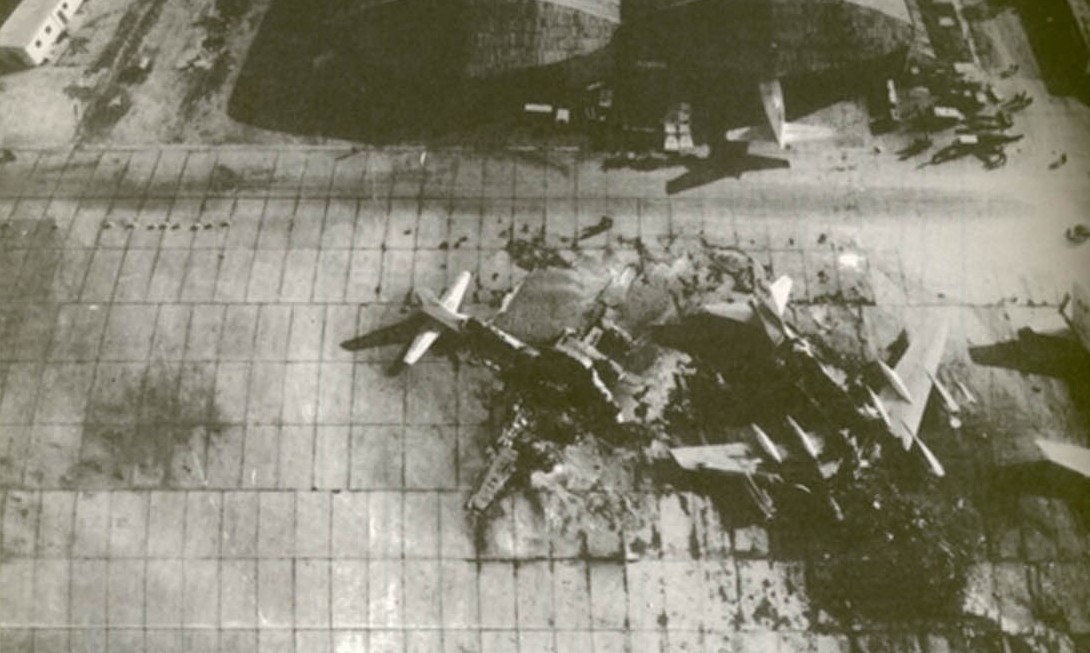
From the air, Beirut Airport looked bright, as if in daylight. The number of aircraft destroyed turned out to exceed the original plan of only four. Not a single member of the team was injured. In total, 14 aircraft (two of them Boeing 707s) were consumed by fire. The value of the loss was estimated at around US$42-44 million. The fruit Israel reaped from its action was the imposition of a weapons embargo sanction by France. President Charles de Gaulle felt he had lost face in front of his colleagues in the Middle East because most of the aircraft and helicopters used were French-made.