

BRIMOB GROWS AND DEVELOPS
After the Republic of Indonesia (RI) was officially established, the members of the Keisatsu Tai and Tokubetsu Keisatsu Tai immediately declared their support for the RI government and formed the Angkatan Moeda Kepolisian Repoeblik Indonesia (AMKRI) as the forerunner of the Indonesian National Police institution. They no longer recognised the leaders of the Japanese military regime as their superiors. The names Keisatsu Tai and Tokubetsu Keisatsu Tai were then changed to Polisi Oemoem and Polisi Choesoes. In certain regions the names used were Polisi Perdjoangan and Polisi Istimewa. It was not only about names, this lack of uniformity spread to organisational structure, work procedures and force distribution, with the result that law enforcement activities in society became chaotic.
Because the young RI needed one complete police institution, the Preparatory Committee for Indonesian Independence (then the highest state institution) ratified the establishment of the Djawatan Kepolisian Negara (DKN) as the umbrella for all police institutions at central and regional level. From then on all existing police units were merged into one and sheltered under the DKN banner (19/8/45). To reinforce this decision, the Commander of the Pasoekan Polisi Istimewa Djawa Timoer, First Level Police Inspector M Jasin, representing all DKN members, issued a proclamation stating that from 21 August 1945 the term “Police” meant the RI police unit responsible only to the RI government. As its elaboration, in several cities AMKRI members (including the Pasoekan Polisi Istimewa) took part in actions to seize weapons and vital installations belonging to the Japanese military regime. The Pasoekan Polisi Istimewa even became the core of RI armed strength when holding back the British invasion of Surabaya in October and November 1945.
Although its role in various battlefields against British and Dutch forces in the early days of RI independence was quite large, until mid-1946 the organisational structure and work procedures of the Pasoekan Polisi Istimewa were still unorganised. Therefore the Deputy Chief of the DKN, First Level Police Commissioner Soemarto, took the initiative to fix it. The name Pasoekan Polisi Istimewa was changed to Mobile Brigade, from the Dutch military term Mobiele Brigade (Rapid Movement Brigade). The Chief of the DKN, First Level Police Commissioner RS Soekanto Tjokrodiatmodjo, asked for help from First Level Police Commissioner M Jasin to realise that police paramilitary force. Finally, on 14 November 1946, the Mobile Brigade (abbreviated Mobrig) was established as the DKN’s assault unit.
Mobrig forces were present in all residency areas still controlled by the RI. In each residency a Residency Mobile Brigade Company (MBK) was formed, headquartered in the residency capital. Each MBK company had a strength of around 100 people, led by a First or Second Level Inspector. Operational control was held by the Residency Police Chief. Each Mobrig company consisted of two sections. Each section was led by a Police Inspector Assistant and consisted of three brigades. Each brigade was led by a police commander and consisted of three groups. And finally each group, headed by a First Level Police Agent, oversaw around six to seven Mobrig members.
In addition to the MBK at residency level, Mobrig also had three reserve forces, namely the Mobrig Besar Djawatan (MBD) based in Purwokerto (DKN Headquarters), the Mobrig Besar Djawa Tengah in Solo and the Mobrig Besar Djawa Timoer in Malang. Operational control of these three Mobrig units was held directly by the Chief of the DKN.
At a very young age Mobrig was already involved in various battles, both with Dutch forces (during the Dutch Military Aggression 1 and Dutch Military Aggression 2) and with communist rebels during the PKI Madiun Rebellion (1948). After the Netherlands recognised RI sovereignty (27/12/49), Mobrig troops were assigned to face various armed insurgencies. Starting from APRA (West Java), DI/TII (West Java, Central Java, Aceh and South Sulawesi), RMS (Maluku), to PRRI-Permesta (Sumatra and Sulawesi). All these rebellions were put down by Mobrig together with other components of the RI Armed Forces (ABRI) by the mid-1960s.
Even though it was very busy taking part in various counter-insurgency operations, Mobrig still managed to reorganise, if only to ease coordination among Mobrig units at regional level. The name Mobrig Besar Keresidenan was changed to Rajon Mobrig (RM). In addition, the Central Mobrig Inspectorate and the Provincial Mobrig Inspectorate were formed. The task of both institutions was to assist the Chief of the DKN in managing all matters related to Mobrig units. With the return of the state capital to Jakarta (1950), all activities of DKN Headquarters and its ranks, including Mobrig, also moved from Purwokerto to Jakarta.
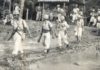



 was born, grew and developed amid the struggle to win and defend the independence of the Republic of Indonesia.)