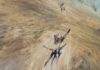



Photo Archive of the 1969 TNI/ABRI Joint Exercise in Cirebon – HobbyMiliter.com – 1969 was the early period of the New Order regime led by General Soeharto in Indonesia. In that year, ABRI (the Indonesian Armed Forces, the combined name for the Indonesian Military and the Police) held a large-scale joint exercise in the Cirebon area. This joint exercise was named Gala Yudha ABRI 1969.
Exercises in the Indonesian Military are usually carried out in stages. They start with routine individual training, then at unit level from squad, platoon, company and battalion. Then there are also exercises across units within one service, such as the Indonesian Air Force’s routine annual Angkasa Yudha exercise. Only then is a joint exercise between services carried out, as the culminating exercise to test the readiness, doctrine and weapon systems of the Indonesian Military.
The documentation in this photo archive of the Gala Yudha ABRI 1969 exercise is interesting, because we can see the readiness of the Indonesian Military and the weapon systems used at that time. Even more interesting, we can still see several weapon systems used in 1969 that were still in use in 2018, almost 50 years later.
We can also see several weapon systems whose presence is quite surprising to us. For example, the French-made ATGM whose procurement took place around 1962-1964. Years in which, as we know, it has been said that Indonesia was embargoed by Western countries.
According to SIPRI, the purchase was also quite large, 500 units. A fairly large number, considering that in that period the countries that had tanks were probably only Indonesia, Thailand and Vietnam. Singapore only bought second-hand AMX-13s from Israel in the early 1970s.
Artillery: 120 mm Mortars and RM-51 Rockets
The gallery below documents that exercise photo by photo, heavy 120 mm mortars, RM-51 rocket launchers, cavalry and marine troops, air defence artillery, Penerbad helicopters, right up to the B-26 Invader bomber and the P-51 Mustang. This is a portrait of ABRI’s strength at the start of the New Order era, more than half a century ago.

In this photo, personnel can be seen preparing a mortar. The mortar in this picture appears to be the Soviet-made PM-43 heavy mortar, calibre 120 mm. This mortar is a crew-served weapon, its task is to provide fire support against enemy fortifications.

The troops manning the Soviet-made PM-43 heavy mortar, calibre 120 mm, are setting up positions along the edge of an irrigation channel. Usually one of these mortars is manned by 6 personnel. Its maximum range is about 5-6 kilometres. If well trained, the gun crew can fire 4-6 mortars per minute.

This blurry photo shows the Indonesian Army MLRS of the era in action in this joint exercise. The Indonesian Army operated the Czechoslovak-made RM-51 rocket launcher, calibre 130 mm. Although its calibre is 130 mm, larger than the RHan for example, which is only 120 mm, because its length is not that great, its maximum range is also short. Only 8 kilometres.

The following photo also appears to be a towed version of the RM-51. The rocket used seems to be the same as the one used by the RM-51, only it uses a towed launcher with a configuration of 8 rockets in 2 stacks. Each stack holds 4 rockets.

The RM-51 MLRS uses a ZIL 6×6 truck as its self-propelled platform. In this photo, Indonesian Military personnel can be seen reloading rockets. One launcher is usually manned by 6 personnel.

Compare it with this 2012 photo. The Indonesian Army RM-51 bought in the 1960s could apparently still fire at Baturaja in 2012. The propellant in its rockets had not yet expired.

The truck-mounted RM-51 and the towed version in one frame. With a range of only 8 kilometres, the BM-21 Grad that strengthened the KKO (Marines) is actually still more powerful. The BM-21 Grad has a range of up to 20 kilometres.
Personnel, Marines, and Cavalry

The uniforms worn by Indonesian Military personnel of that era. Complete with wooden-stock AK-47s and steel helmets.

ABRI personnel carrying out a ground operation in the Gala Yudha 1969 joint exercise. Judging by the uniforms worn, these personnel appear to be from the KKO (Indonesian Navy Marines).

The position of a KKO member with his squad machine gun, the RPD. To this day the RPD remains a mainstay of the Marines.

Indonesian Military personnel conducting military training in Cirebon. Local residents can be seen gathered watching from across the road. Squatting at the very front appears to be the documentation team taking photographs. This scene looks like a scene from the film Saving Private Ryan.

A signals corps member with his radio. Beside him is a Marine with his AK-47. Apparently the radioman carries no weapon for self-defence.

A KKO squad with AK-47 rifles and an RPD as the squad machine gun, awaiting orders. Apparently one of the things being trained is urban warfare, fighting in the middle of a city.

Alvis Saladin and Alvis Ferret combat vehicles patrolling the streets with foliage camouflage. The Ferret and Saladin were bought by the Indonesian Military from Britain in the 1960s. And to this day both still serve in Indonesian Army cavalry units.

Another photo of the Ferret and Saladin duo. The Saladin is a British-made cannon armoured car. Note the railway tracks at the side of the road.

Indonesian Military personnel with an SMG. From its shape, this SMG is either a German-made MP28 or a British-made Lanchester submachine gun, which is a direct copy of this MP28.
Air Defence Artillery, Army Aviation, and ABRI Air Power in 1969

Personnel of an Air Defence Artillery battalion with the S-60 system, calibre 57 mm. Although it still operates today, the S-60 in 1969 apparently was still more formidable than now. Note in the background there is a Grom-2 radar and also a Fire Direction unit called PUAZO. The combination of the two is called the SON-9 system.
How it works: the guns and the SON-9 are set up and connected by cable. After synchronisation, an incoming target is detected and tracked by the Grom-2 radar, and its PUAZO directs the connected guns automatically onto the target. This Fire Control equipment allows S-60 shells to effectively cut down low-flying targets.

Air mobility was provided by Penerbad with the Soviet-made Mil Mi-4 Hound helicopter. This helicopter can carry 10-14 troops.

ADRI, AURI and ALRI all once operated this Soviet-made Mil Mi-4 Hound helicopter. This helicopter is quite unique because the pilot’s cabin sits perched above the passenger cabin.

Besides that, Penerbad also brought the French-made Alouette III helicopter.

It turns out the Indonesian Army once had 500 ENTAC anti-tank missile units. This French-made missile could destroy armoured vehicles at a range of up to 2 km. When launched, the operator “steered” the missile manually via a joystick, which was then passed on to the missile flying towards its target through a wire, similar to how the TOW missile operates.

An Indonesian Air Force pilot flies the B-26 Invader bomber. This bomber, bought from America in the early 1960s, was operated by Air Squadron 1.

This B-26 Invader was reportedly bought by the government after the Air Force was impressed by the performance of the B-26 used by Alan Pope and PERMESTA in bombing Republic assets, one of them the KRI Hang Tuah and a British tanker that was bombed until it sank by PERMESTA.

It also flew the P-51 Mustang. In this photo, one P-51 Mustang numbered F-356 with the special “ORDE BARU” marking on its airframe can be seen crash-landing and overturned at Penggung air base, Cirebon. This incident happened on 6 November 1969. The pilot was recorded as surviving.

There are also several weapon systems the author does not recognise, in action in this joint exercise. For example, this rocket. At a glance it looks like the SA-2 Guideline/S-75 Dvina SAM rocket that strengthened the Indonesian Air Force.
But no, this is not the S-75 Dvina. If examined carefully, there are very many differences between them. Can readers help identify this weapon system?
It could be an experimental surface-to-surface rocket developed by the military, considering that in this era there was quite a lot of scientific rocket development, among them the KARTIKA rocket and the AHMAD YANI rocket.

Besides that, this rocket too. At a glance it looks like an ATGM with a rail launcher on top and its missile hung below the rail. But the author does not yet have a reference for any ATGM shaped exactly like the rocket in this photo.
It could also be an experimental rocket belonging to ALRI, which indeed has a similar configuration. Can readers help identify this weapon system? (Do not forget to fill in the comments below).