

REORGANISATION AND REFUNCTIONALISATION OF BRIMOB DUTIES
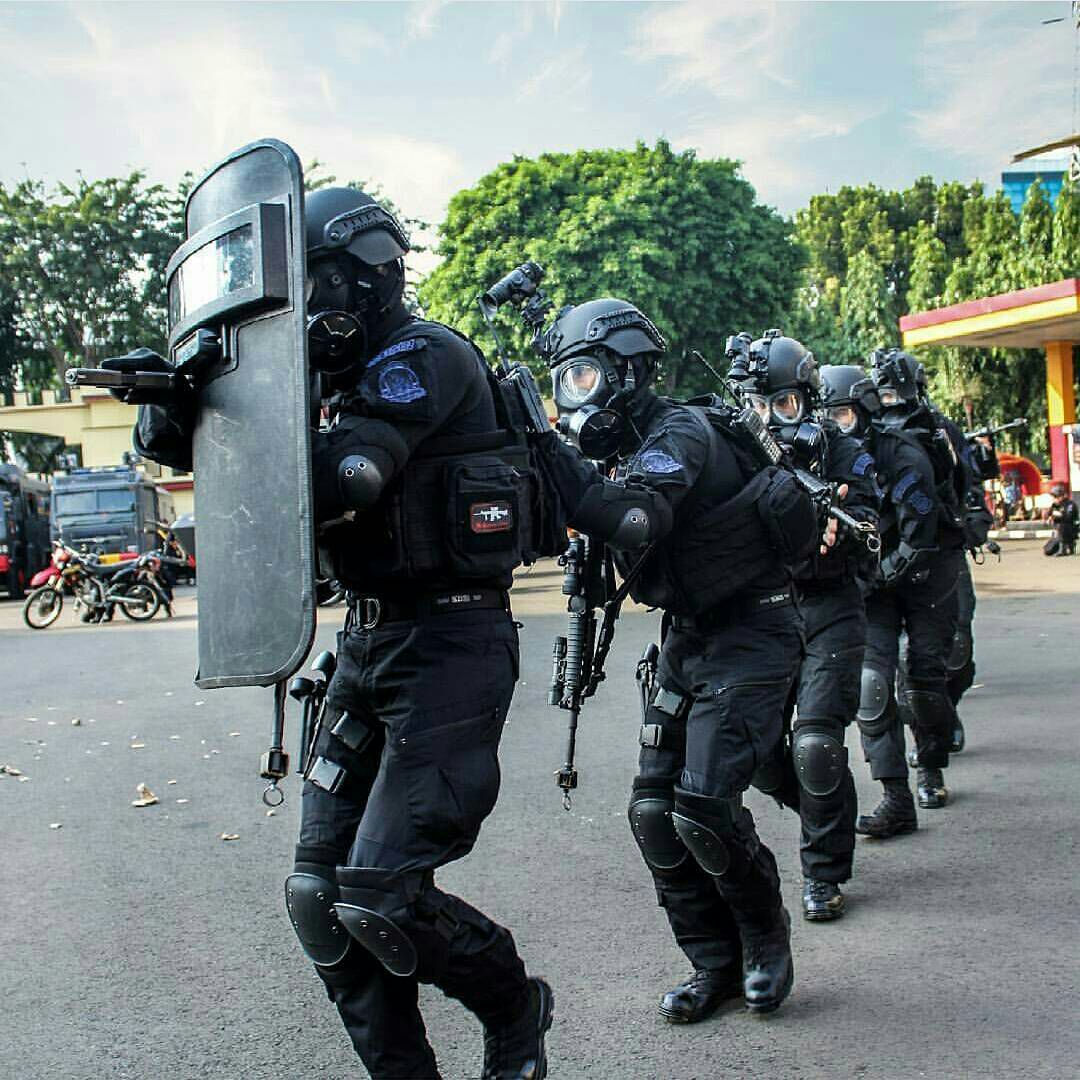
Until early 1974, Brimob was the only combat unit in the ABRI ranks that already had counter-terror capability. Within Brimob this capability was mastered by a small unit under the control of the Metro Jaya Regional Police Chief. This elite and secret unit was named Gegana (Sky). This unit was expected to one day be able to handle every form of terrorism in civil and military aircraft. However, since 1976 Gegana has instead deepened the science of defusing explosive devices rather than deepening counter-terror capability.
In the early New Order era Brimob was trusted to carry out police duties in maintaining security. Ironically, the ABRI leadership at the time still imitated the Tokubetsu Keisatsu Tai concept as a reserve force, so Brimob was also functioned as a component of the ABRI reserve force. Later the ABRI leadership returned Brimob’s function to its basic role as a law enforcement institution and reduced its combat capability. This ABRI leadership policy was spelled out by the Police leaders in the form of the National Police Chief Decree No. Pol SK/05/III/1972 which regulated the refunctionalisation and reorganisation of the Brimob Corps (02/3/72). Since then operational control of Brimob units at provincial level has been held by the Regional Police Chief (Kapolda).
After reorganisation, the strength of each Brimob unit was limited only to battalion level. Meanwhile, all Brimob companies that had become standalone units were transferred to become organic units in each Regional Police. Brimob’s role is now as a tactical operational support unit for the police. The focus of its responsibility is no longer on combat duties but on handling all forms of high-intensity crime that ordinary police units cannot face. In 1983 Brimob was reorganised again. Through the National Police Chief Decree No. Pol: Skep/552/XI/1983, in each Regional Police a Brimob battalion was formed with a strength of several companies (14/11/83).
Brimob had to swallow a bitter pill after ABRI Commander General TNI LB Moerdani removed the Menpor vocational training programme from the syllabus of the Brimob Education Centre in Watukosek (1983). The reason was to make the ABRI posture leaner and to avoid overlapping authority among fellow ABRI combat units. This policy ran counter to the efforts to improve Brimob’s capability pioneered by General TNI M Jusuf since 1978. When the ABRI command baton was held by General TNI Feisal Tandjung, there was a plan to again hand over responsibility for handling security and public order disturbances (kamtibmas) to Brimob (1993). But this plan received little response from ABRI leaders. Moreover, Brimob itself felt its capability as a paramilitary unit had greatly diminished.
Since 1996 Brimob has no longer been led by a middle-ranking Police officer but by a one-star senior Police officer. Still in the same year, 15 members of Gegana Regiment II successfully completed free-fall parachute training in Margahayu, Bandung. These fifteen Gegana Regiment personnel then became Brimob’s capital to open its own free-fall parachute school at Brimob Headquarters in Kelapa Dua. Until now, although not mandatory, most members of the Gegana Regiment have free-fall parachute capability.
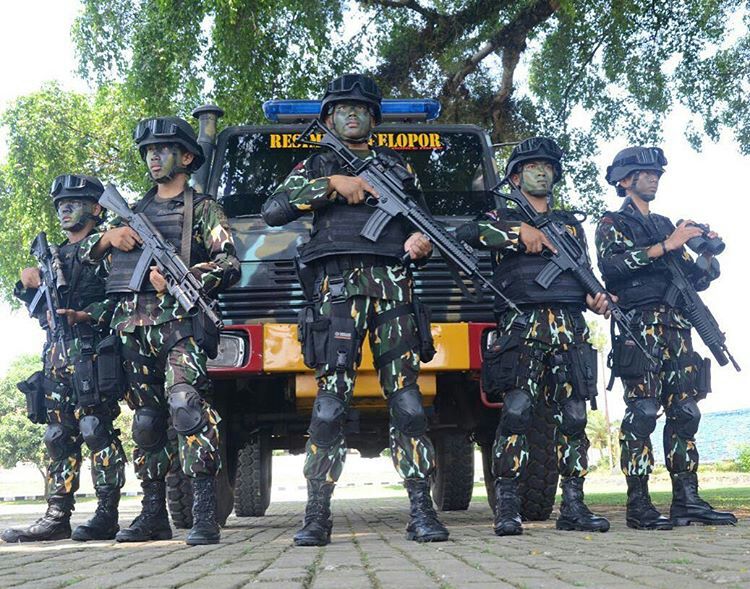
Towards the end of the New Order era, Police leaders again intended to restore Menpor as their striking unit (1997). To realise this dream, in October 1999 a training programme for prospective Menpor personnel was opened. After being trained for five months in Watukosek, 48 people succeeded in earning the ranger qualification badge and then became the initial capital for the re-establishment of Menpor. Gradually the training period for prospective Menpor members was shortened to four and a half months. Given the high level of need for Brimob personnel with ranger qualifications, the training duration for prospective Menpor members was shortened again to only three months.
In the Reform era, the kamtibmas condition experienced a setback. Mass riots and horizontal conflicts with SARA nuances were rampant in a number of regions. The peak was a series of bombings of various civil objects in a number of places (1999). To deal with high-intensity kamtibmas disturbances, especially bombings, each Regional Police sent several of its Brimob members to take courses in recognising and defusing explosive devices at Gegana Regiment Headquarters. After returning from the course, the regional Brimob members then formed Gegana units in each Regional Police under them. The existence of these Gegana units only became official when the National Police Chief Decision No. Pol. Kep. 54/X/2002 was issued on the ratification of the existence of Gegana sub-detachments in each Brimob unit at Regional Police level.
With the growing number of Korps Brimob members who had passed Menpor prospective training, Brimob then formed two new Menpor units. At the same time the strength of Gegana Regiment II was also expanded from two to four detachments. Because de facto the Gegana Regiment was born earlier than the two new Menpor units, the unit numbers were then changed to Gegana Regiment I (Kelapa Dua), Pioneer Regiment II (Kedung Halang) and Pioneer Regiment III (Kelapa Dua). Like Gegana, Pioneer Regiment II and Pioneer Regiment III each had a strength of four detachments.
Exactly on the 57th anniversary of the Police, all Brimob members wore black uniforms which previously could only be worn by members of Gegana Regiment I. So that the militaristic impression within the Brimob Corps could gradually be removed, at the beginning of 2004 the term “Regiment” was changed to “Unit”. Since then the official names Satuan I Gegana, Satuan II Pelopor and Satuan III Pelopor have applied.

 was born, grew and developed amid the struggle to win and defend the independence of the Republic of Indonesia.)