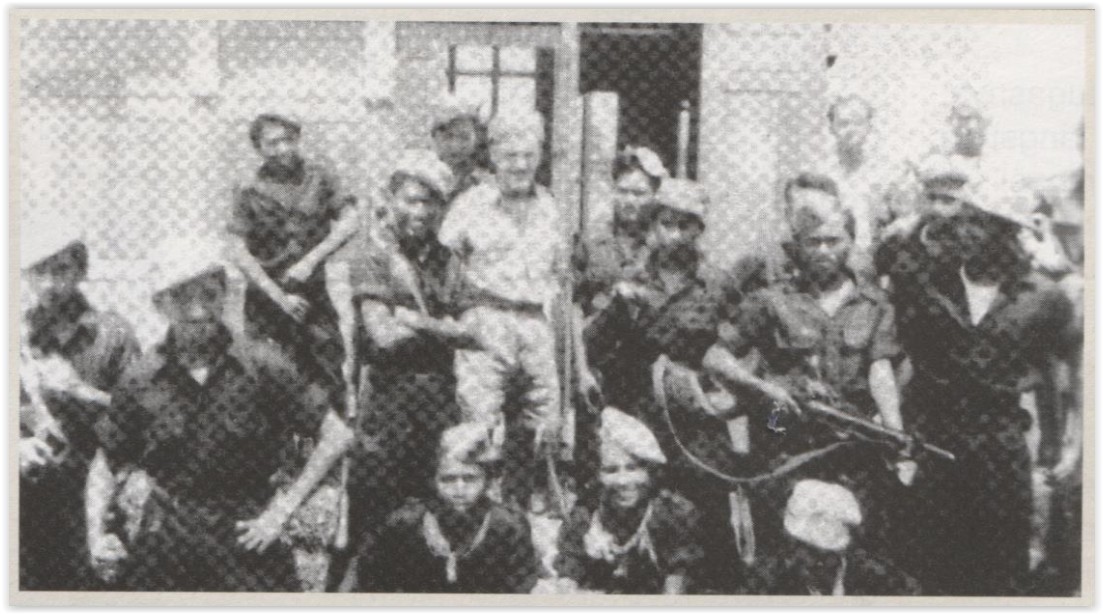
The SOT was a combination of an officer education programme and a senior secondary school (Sekolah Menengah Tinggi, SMT). This was based on the thinking that if the situation later recovered, its participants, who were basically students who had joined the struggle, could continue their education at public schools. Major General Djatikusumo ordered several of his staff, Darsono (former head of a teacher training school), Soemarso (former CORO, Cursus voor Opleiding van Reserve Officieren, the Dutch East Indies Reserve Officer Candidate School) and Sukamto (former PETA, Pembela Tanah Air, Defenders of the Homeland, a Japanese-formed paramilitary force) to draw up the SOT curriculum.
It was estimated that if there were no obstacles, the SOT participants could be appointed as officers and skilled at leading up to company level after 18 months of education. Major General GPH Djatikusumo himself gave the lessons on military affairs, while general subjects were taught by several secondary school teachers.

Besides receiving theory in class and doing field practice, the SOT students were also given a task by Major General GPH Djatikusumo to escort the transport of Allied prisoners of war and internees (APWI) from Banyubiru (Ambarawa) to Panasan (now Adisumarmo airfield, Boyolali) to be flown to Jakarta or Semarang. Major General GPH Djatikusumo chose the SOT students to carry out this task because its scope was international. As students, many of the SOT students mastered English and Dutch. Besides giving the students experience, it also showed that Indonesia had an army that was organised, disciplined and able to communicate in foreign languages.
The SOT programme ended in June 1946 and a combat capability examination was held by Major General GPH Djatikusumo to determine whether the students graduated. Students who passed received an SOT diploma signed by Lieutenant General Urip Sumoharjo as Chief of the TKR General Headquarters and Major General GPH Djatikusumo as Commander of TKR Division IV. Some of the SOT participants then continued to public schools (to senior high school and university) and some remained in military service. This was in line with the nature of SOT officers as reserve officers.