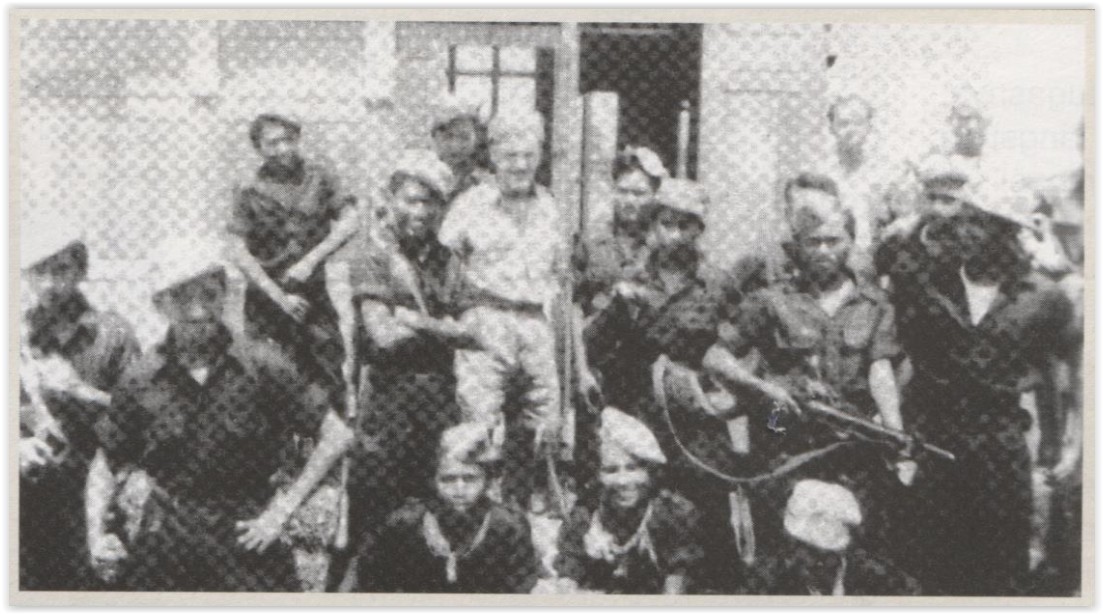
KSAD Colonel Djatikusumo issued an assignment order to the T Troops to carry out territorial and intelligence operations in Purwodadi, Pati, Kudus and Jepara regencies in October 1948, aimed at assisting the restoration of the civilian government and acting as liaison officers with the Siliwangi Division troops tasked with crushing the PKI Madiun rebellion.
In carrying out their duties, they were directly responsible to the KSAD and coordinated in the field with the Military Governor of Central Java, Colonel Gatot Soebroto. This assignment became a new experience for the members of the T Troops because the emphasis was on territorial development and intelligence, and they dealt directly with the people, the local government and the military elements in place. Some of them were even assigned as Military Wedana and Military Subdistrict Heads because the local civilian government officials had been killed by the PKI or had fled.
THE SECOND DUTCH MILITARY AGGRESSION

The Second Dutch Military Aggression on 19 December 1948 split the members of the T Troops across two fronts. Those still serving in Pati and its surroundings after the recovery from the PKI Madiun rebellion waged guerrilla warfare around Mount Muria, facing Dutch Marine forces that landed in Rembang and their infantry forces from Semarang. The equipment and weapons they used were supplemented with spoils taken from the PKI rebels, such as LE rifles, Steyr/Hembrug rifles formerly of the KNIL, Arisaka rifles formerly of the Japanese, and hand grenades. Some of the T Troops members on this front were Major Munadi, Captain Ali Mahmudi and First Lieutenant Slamet Danusudirdjo.
The second front was faced by members of the T Troops who had finished senior high school in Magelang and who were studying at university in Yogyakarta. They waged guerrilla warfare around the Kulon Progo river basin, Mount Sumbing and Wonosobo. They were led by Second Lieutenant Sudharmono (who later became Vice President of the Republic of Indonesia). Their equipment was better. Besides using LE rifles, Steyr/Hembrug rifles formerly of the KNIL, Arisaka rifles formerly of the Japanese and hand grenades, they were also equipped with Schmeisser submachine guns and Japanese mortars complete with their ammunition. Members of these T Troops managed to launch a general attack on the town of Magelang on 17 January 1949 at 00.00, and although the main objective was not to capture the town, the attack managed to make the Dutch troops panic at their posts.