US Navy Doubles E-130J Phoenix II Test Fleet With $1.13 Billion Northrop Grumman Contract – HobbyMiliter.com – The United States Navy is doubling the test fleet of its strategic communications aircraft, the E-130J Phoenix II, through a $1.13 billion contract modification awarded to Northrop Grumman. The US Department of War announcement on November 25, 2026, orders three additional system demonstration test aircraft plus initial spares, bringing the number of test aircraft in the program to six.
The modification uses a cost-plus-incentive-fee scheme and is worth exactly $1,130,397,498, with work scheduled for completion by January 2030. Of that value, only $4.18 million in fiscal 2027 research, development, test, and evaluation funds was obligated at the time of award. The core event is consistent across all six sources read for this article.
The three additional aircraft complete the three Engineering Development Models ordered under the main development contract, worth $3.459 billion, on December 18, 2024. That contract also included options for three system demonstration test aircraft and up to six aircraft in the first production lot, and the test aircraft option has now been exercised. According to Army Recognition, the order came 41 days after the Navy accepted its first C-130J-30 Super Hercules airframe on October 15, 2026.
The E-130J Phoenix II is being built to take over the Take Charge and Move Out (TACAMO) mission, the airborne link between US national leadership and ballistic missile submarines on patrol underwater. A TACAMO aircraft trails a pair of very long wire antennas behind it, then flies a tight circular orbit so the wire hangs almost vertically beneath the fuselage. From that position, the aircraft transmits Very Low Frequency (VLF) signals that can penetrate seawater and reach a submarine without forcing the boat to rise near the surface. According to AeroMorning, it carries only short, structured command messages, not voice traffic. The mission is designed to keep working during and after a nuclear attack.
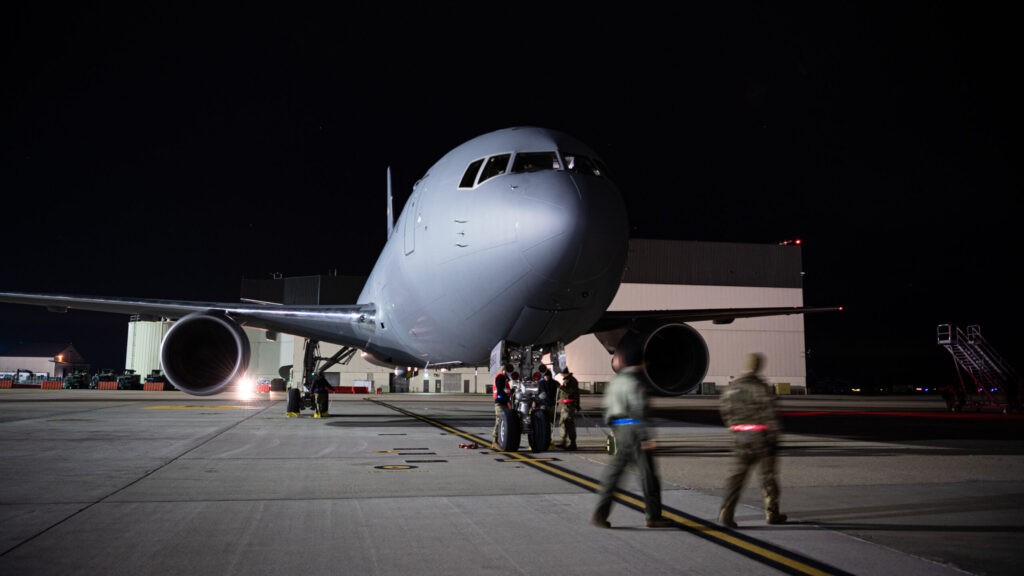
The platform is the Lockheed Martin C-130J-30 Super Hercules, a stretched airframe that is still in production. According to Army Recognition, it is powered by four Rolls-Royce AE 2100D3 turboprop engines rated at 4,700 horsepower, each driving a six-blade Dowty R391 propeller, and its fuselage is 4.57 meters longer than the standard C-130J. Northrop Grumman is the prime contractor and mission systems integrator, Lockheed Martin supplies the airframes, and Collins Aerospace supplies the very low frequency communications system. Work under the latest modification is spread across several US locations, with the largest shares in Melbourne, Florida, at 35 percent, Marietta, Georgia, at 23 percent, and Richardson, Texas, at 15 percent.
The aircraft being replaced is the E-6B Mercury, a Boeing 707-based jet whose first flight took place on February 19, 1987, and which now numbers 16 aircraft. The whole fleet was converted to the E-6B standard between 1997 and 2006, according to Army Recognition. The 707 itself has been out of production since 1991, so sustaining the aging fleet is getting harder and more expensive. The E-6B also carries a second mission, the Looking Glass airborne command post, which can relay launch orders to Minuteman III intercontinental ballistic missiles. According to Defence Blog, the E-130J will take over only the TACAMO mission, so the Looking Glass mission still has no named successor. The name Phoenix II refers to the history of the mission, because TACAMO once flew on EC-130Q Hercules aircraft from 1963 to 1993.
The scale of the program is large. According to a Pentagon acquisition report dated April 21, 2026, cited by Defence Blog and Army Recognition, the Navy plans to buy 31 E-130J aircraft, consisting of six pre-production aircraft and 25 production aircraft, to replace the 16 E-6B aircraft. The estimated acquisition cost of the program reaches $25.985 billion in then-year dollars. The program acquisition unit cost, including development, reaches $732.8 million in constant dollars, while the average procurement cost of each production aircraft reaches $360.9 million.
The schedule of the program is under pressure. According to a July 2026 report by the Government Accountability Office (GAO), the low-rate production decision slipped by about a year to April 2029, because of difficulties adapting existing mission equipment to the smaller C-130J-30 airframe. According to Defence Blog, the GAO had already warned in June 2025 that the C-130J might not meet operational availability requirements. The preliminary design review took place on March 31 to April 1, 2026, while the critical design review is only targeted for late 2027, according to Army Recognition. Initial operational test and evaluation is not scheduled before June 2033, and the initial operational capability date remains classified. According to Army Recognition, the Pentagon requested $1.7 billion for TACAMO modernization in fiscal year 2027.
With these three additional test aircraft, the Navy can run flight testing in parallel rather than in sequence, reducing the risk of a capability gap as the E-6B fleet grows older. According to Army Recognition, the E-6B is to remain in service through fiscal year 2038. Moving from a jet to a turboprop on an airframe that is still in production may look like a step backward, but the Navy values the wide logistics support and lower operating costs in return. For the submarine leg of the US nuclear triad, a reliable communications link is not a luxury, but a requirement so that orders from national leadership always get through, under any conditions.
Source: Interesting Engineering, Naval Technology, AeroMorning, Army Recognition, Defence Blog, Envanter Medya.