

How Afterburners Work – HobbyMiliter.com – People often ask, why are fighter aircraft equipped with afterburners? What are they for? An afterburner, or reheat, is a method used to increase the thrust of an aircraft engine in a short time. This capability is generally applied to aircraft for takeoff, climb, and achieving good combat performance.
Supersonic commercial transport aircraft such as the Concorde used afterburning engines to cross continents in a shorter time. With four Rolls-Royce/SNECMA Olympus 593 Mark 610 afterburning turbojet engines, a thrust of 170 kN per engine was produced at takeoff, and it sped through the air at speeds of up to Mach 2.
Interceptor aircraft are equipped with afterburners, among other things to chase the enemy or evade the pursuit of advanced high-speed missiles. By combining afterburning engines with other technologies such as thrust vectoring and radar jammers, the aircraft becomes superior.
In 1953, US Navy pilot James B. Verdin first tested the Westinghouse X140-WE-8 afterburning turbojet engine on the Douglas XF4D-1 Skyray aircraft (later becoming the F-6). This aircraft was previously powered by a J35-A-17 turbojet engine without an afterburner with 5,000 pounds of thrust. As a result, with the new-style engine with 11,600 pounds of thrust, the Skyray sped along at 752.94 miles per hour over a distance of three km above the Salton Sea, California. This success set a new world flight speed record.
How Does an Afterburner Work?
An afterburner is an additional combustion chamber placed behind the turbine of a jet engine. The way it works is simple. Fuel is sprayed directly into the exhaust gas flow, which is still very hot and still contains oxygen, and is then burned for a second time. This second combustion raises the temperature and speed of the exhaust gas drastically, so thrust jumps, generally around 50 percent, and on some engines even close to double, within seconds.
The Weakness of the Afterburner: Extraordinarily Wasteful
That extra power is paid for very dearly. Fuel consumption when the afterburner is lit at full can rise three to four times compared to normal cruising power. That is why pilots only use it at critical moments, taking off from an aircraft carrier or a short runway, climbing quickly to intercept, hard maneuvering in air combat, and breaking the speed of sound. An aircraft that flies for long with its afterburner on will run out of fuel within minutes.
Afterburner vs Supercruise
The ability to break the speed of sound without an afterburner is called supercruise, and only a few aircraft are capable of it, among them the F-22 Raptor and the Eurofighter Typhoon in certain configurations. The difference is big. An aircraft that relies on an afterburner can only go supersonic briefly, while a supercruise aircraft can maintain supersonic speed far longer and more economically. Even though it is wasteful, the afterburner remains a standard feature of almost all modern fighter jets because there is no other way as fast and as simple to get emergency thrust.
A Brief History of the Afterburner
The afterburner principle, in Britain called reheat, was developed toward the end of World War II, when German and British engineers raced to add thrust to the still weak first-generation jet engines. The first operational afterburner was used in the late 1940s, and in the 1950s this technology became the key to the birth of the first supersonic fighter jets such as the F-100 Super Sabre. Since then, there has been almost no supersonic fighter jet without a tailpipe that can spit out this blue-orange tongue of flame.
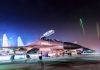
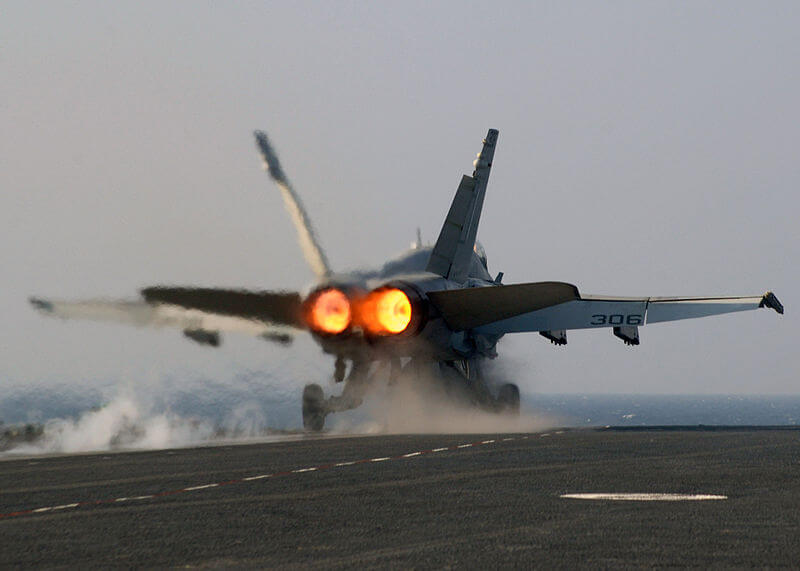
Its visual signature is easy to recognize. When the afterburner lights, a bright cone of flame appears from the tail of the aircraft with a shock diamond pattern, pressure waves visible as bright bands inside the burst of flame. At night or at dusk, the afterburner flame is the most dramatic sight in the world of military aviation, as well as a sign that the pilot is asking for all the power that his engine can give.
Read also: Mitsubishi T-2, an example of a twin-engine fighter jet from the era when the afterburner became standard.