The Mesolithic Age: Definition, Characteristics, Remains, and Cultural Products – HobbyMiliter.com – What is meant by the Mesolithic Age? And what are the cultural products of the Mesolithic Age? Let us look at the answers in our explanation below about the Mesolithic Age.
When we study history in high school, we will certainly learn about the Prehistoric Age in Indonesia, the time before there were kingdoms or before the Common Era. The prehistoric age is divided into 2, namely the Stone Age or Lithic Age and the Metal Age.
Then the Lithic Age is divided into 4 ages, namely the Paleolithic Age (Old Stone Age), the Mesolithic Age (Middle Stone Age), the Neolithic Age (Young Stone Age) and the Megalithic Age (Large Stone Age).
And of the four stone ages, here we will discuss the Middle Stone Age or the Mesolithic Age.
Definition of the Mesolithic Age
The Mesolithic Age, or Middle Stone Age, is a prehistoric period when humans who in the previous age still moved from place to place (nomadic) had largely begun to live settled in one place.
The Mesolithic Age also took place 10 million years before the Common Era, the era when kingdoms existed in Indonesia. The Mesolithic Age was a transitional period from the Paleolithic Age to the Neolithic Age.
In this age humans carried out their daily activities by catching fish and hunting. As time passed in this new age, prehistoric humans began to settle in places such as caves and beaches. In this age prehistoric humans found a new occupation, namely farming. So what are the cultural products of the Mesolithic Age left behind?
Characteristics of the Mesolithic Age
The Mesolithic Age has the following characteristics:
- Humans lived semi-settled, occupying caves (abris sous roche) and seashores.
- Their livelihood was still hunting and gathering food (food gathering), beginning to shift toward producing food (food producing).
- Stone tools were already partly sharpened, including the Sumatran hand axe (pebble), the short axe (hache courte), and tools made of bone and horn.
- Kjokkenmoddinger were found, namely kitchen waste heaps of shells and snails on the seashore.
- Cave wall paintings and the tradition of burying the dead inside caves were known.
Remains and Cultural Products of the Mesolithic Age
In every age there is a culture left behind, including in the Mesolithic Age. There are several cultural products of the Mesolithic Age left behind, such as:
1. Living in Caves or Abris Sous Roche
We can learn about the cultural products of the Mesolithic Age from research conducted in Lawu Cave in the Ponorogo area by a Dutch researcher named Van Stein Callenfels. He conducted research at Lawu Cave and found many tools made of bone, which are thought to be remains from the Mesolithic Age.
2. Toala
Another cultural product of the Mesolithic Age is Toala. Toala is a culture of burying humans who have died inside a cave, and after the human bones dry out they are kept as keepsakes by their family.
In addition, among the Toala people there is also a cave with paintings and carvings about pig hunting on its walls. The Toala people are in South Sulawesi province, and in that area there is a cave with many Mesolithic remains such as flakes or serrated and black flake tools, tools made of bone, animal skins, pottery, grinding stones, and pebbles.
3. Sumatran Axe
The Sumatran axe, as its name suggests, is a Mesolithic remain found in the Sumatra region. This axe resembles a hand axe, but has a different shape from the axe found in the Paleolithic Age.
This Sumatran axe is often found on the seashore, because the seashore was a place frequently used by humans in the Mesolithic Age as a dwelling. This axe was used as a hoe for farming.
This pebble can also be used to smooth grains and to make red paint, to kill hunted animals, as a weapon for self-defense, and to pound tree fibers. The pebble has an elongated shape that is flaked to become sharp.
4. Beach Garbage Heap or Kjokkenmoddinger
The next cultural product of the Mesolithic Age is called kjokkenmoddinger, or beach garbage heap. Mesolithic humans who chose to live on the banks of waterways chose that place because it had fertile soil and a water source for life.
Mesolithic humans who lived on the seashore as their dwelling left piles of snail and shell remains on the beach.
5. Short Axe / Hache Courte
Then there is the hache courte, or short axe. This axe has a small shape. The short axe is smaller than the hand axe, about half the size of the hand axe. This axe has a semicircular shape and has a sharp and pointed part on its curve.
The short axe, or hache courte, in the Mesolithic Age was used to dig the ground to look for food or to cut fruit.
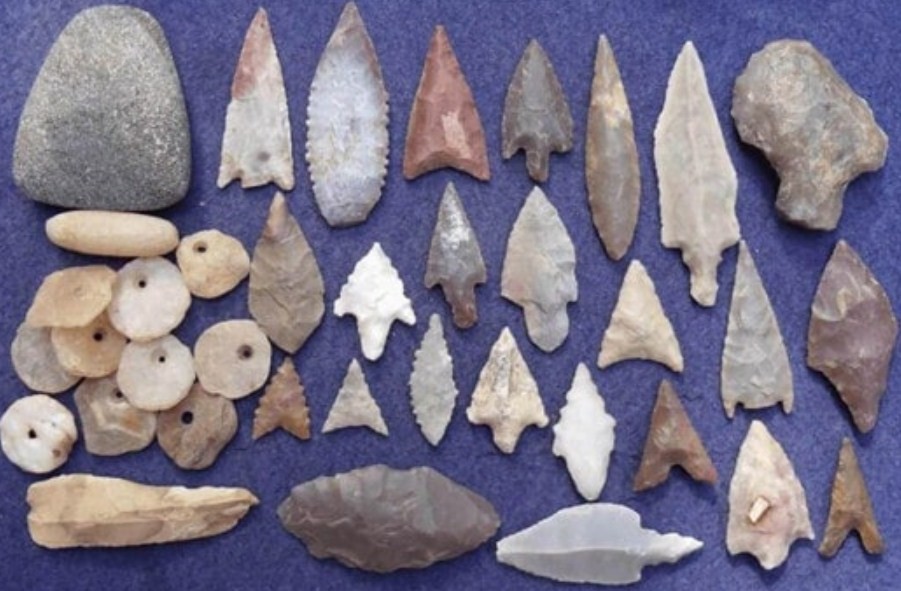
In addition to the 5 cultural products explained above, there are other Mesolithic cultural products such as the grinding stone, the Bacson–Hoabinh culture, serrated arrowheads, and the bone culture from Sampung (Sampung Bone Culture).
Also read: Definition, History, and Characteristics of the Archaean Age, the oldest age in the history of the earth, long before the Mesolithic Age.
Also read: Early Humans in Indonesia: Types, Characteristics, and Remains.
Also read: The Neolithic Age: Definition, Characteristics, and Cultural Products.
Also read: The Paleolithic Age: Definition, Characteristics, and Cultural Products and The Megalithic Age: Definition and Cultural Products (Menhir, Dolmen, Sarcophagus, Waruga).
Translator notes:
– The source dates the Mesolithic Age to 10 million years before the Common Era. Translated as written, although the Mesolithic is generally dated to around 10,000 years ago.
– The source wrote the researcher’s name as Van Steil Callenfels, corrected to Van Stein Callenfels.
– The source wrote Pabble and Pablle, corrected to pebble.