Fretilin Weapons in the Early Days of Operation Seroja – HobbyMiliter.com – This article is a piece by Mas Parind from his website, which is gone, ammochambers.com. Whether he forgot where he put it or what happened to him, how could it have disappeared.
When Indonesia launched the military operation codenamed “Seroja” to annex East Timor (then called Portuguese Timor), the Portuguese colonial government and its forces had already left, leaving behind a pile of weapons to the former Tropaz troops and other militias who were mostly native sons of Timor. It was only light firearms or light weapons normally used by the Infantry, and there is no definite data on how many there were, but it is estimated at more than a thousand pieces.
Those various weapons were then used by the local factions in East Timor at the time: UDT, Apodeti, and of course Fretilin.
History records that in the end UDT and Apodeti sided with Indonesia to integrate East Timor, leaving Fretilin standing firm on independence and waging resistance against the Indonesian forces and their allies. As a note, most of the former Portuguese weapons fell into the hands of Fretilin forces.
As the fighting between the two sides grew more intense and time passed, the types of weapons Fretilin obtained also became more varied, most of them of course captured from the Indonesian military. But here we will limit ourselves first to the types of weapons already held by the anti-integration forces before the Indonesian Armed Forces entered East Timor.
Fretilin Weapons: Pistols and Rifles
Walther P-38/P-1 Pistol
This pistol from the German manufacturer Walther Arms was one of the standard pistols of the Portuguese armed forces. The Walther P-38 was designed to replace the Luger P-08, which was considered expensive. The P-38 variant was produced from 1939 to 1945, while the P-1 variant was produced from 1957 to 2000. This semi-automatic pistol in 9×19 mm caliber was usually carried by Fretilin commanders in the field.
Mauser Rifle
Fretilin forces, who were said to have the full support of the former Tropaz, used the Mauser Kar98/937 Portuguese contract bolt action rifle. This rifle in 7.92×57 mm caliber was a rifle inherited from the Portuguese colonial forces. Some sources also mention that Fretilin used the Swedish Mauser rifle, which uses 6.5×55 mm caliber ammunition.
M948 FBP SMG
The M948 FBP is a Portuguese-made Sub Machine Gun in 9×19 mm caliber. This SMG had already seen wide service with Portuguese forces in their colonial wars in Africa. From photographs, militias can be seen carrying this little-known submachine gun, which at a glance looks like an MP-40 or a Grease Gun.
G3 Battle Rifle
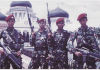
Now, if a Fretilin militiaman who was still a newcomer was usually issued a rifle of the bolt action Mauser class, it was different for the combatants who had long been under Portuguese tutelage (the former Tropaz). These troops could usually be recognized by their neater appearance, not too bearded, often wearing uniforms, and carrying a G3 rifle as their weapon.
The performance of the G3 rifle plus the military skill of the former Tropaz, which was more capable than the average militiaman, often became a terror for Indonesian troops who faced them on the battlefield (especially perhaps for soldiers carrying the SP1). The G-3 Battle Rifle is in 7.62×41 mm caliber, with semi and full automatic fire capability.
Now, the rifles in the hands of these Fretilin soldiers most likely did not come from the German manufacturer Heckler & Koch, but from Portugal itself, where the Portuguese domestic arms industry, Fábrica de Braço de Prata, also produced the G3 in large numbers for their own forces. The G3 itself was the service rifle of the Portuguese armed forces for decades.
Machine Guns and Infantry Mortars
From several battle stories heard during the Seroja period, there are tales of Indonesian troops being held up by machine guns or showered with mortar fire. Yes, Fretilin also operated several types of machine guns and infantry mortars. Tracing them from the standard weapons of the Portuguese forces themselves, here are several types of machine guns and mortars used as Fretilin weapons in facing ABRI at the time:
Madsen Light Machine Gun
This light machine gun made by Compagnie Madsen A/S of Denmark was one of the light machine guns used by Portuguese forces. Designed in 1896. The Madsen LMG was one of the most enduring weapons from the Russo-Japanese War, World War I, to the most recent conflicts happening in the world today. In several battles, Indonesian troops seized Madsen LMGs from the hands of Fretilin militiamen who were killed or surrendered.
MG-34 GPMG
First operated by the German military in 1936, the multi-purpose machine gun (or what we usually call a medium machine gun or squad machine gun), the MG-34, which uses 7.92×57 mm Mauser ammunition, was considered the most advanced weapon of its type at the time. The Portuguese also used this GPMG in their armed forces, and in the case of East Timor, many of them changed hands to Fretilin forces.
MG-42 GPMG
The MG-34, for all its success, was still considered quite expensive and complicated to produce. So the German military intended to find another machine gun alternative that was cheaper and easier to make. The MG-42 was born (although it turned out the MG-34 also continued to be produced until the end of the war). Like its predecessor, the MG-42, which also uses 7.92×57 mm Mauser caliber ammunition, became a terror for the Allied forces who faced German soldiers in World War II. The Portuguese Armed Forces also adopted and used the MG-42 in their colonial war. This machine gun was also used by Fretilin as a weapon to fight the ABRI who came to East Timor at the time.
M2 60 mm Mortar
This United States-made mortar was developed from its heavier version, the M1, which carries an 81 mm caliber. The M2 in 60 mm caliber is used to provide lighter fire support for forces at company level. With a firing range of up to 1.8 km and in use since World War II, the M2 Infantry Mortar still exists in several parts of the world today. One of the parties that once operated it was the Portuguese Armed Forces.
Morteirette de 60 mm
Not supported by a tripod, this Portuguese-made mortar is operated by holding the mortar at the desired angle while stepping on the mortar’s carrying strap made of strong leather. Although considered very mobile and able to quickly provide fire support, this mortar has shortcomings in stability and firing range.
In addition to the several types of light firearms mentioned above, Fretilin also used various other weapons such as land mines (it is recorded that a Marine PT-76 tank was damaged after hitting a land mine planted by Fretilin and killing its entire crew) and hand grenades of various types.