

So This Is How Radar Works, the Eyes and Ears of the Air Force – HobbyMiliter.com – Radar is an abbreviation of Radio Detection and Ranging. This device is vital for state security. It is usually installed both for defense purposes and for civil aviation safety.
One day in March 2004, the civilian radar station belonging to Angkasa Pura at Soekarno-Hatta Airport once malfunctioned. Soekarno Hatta Airport was made chaotically congested when the radar that served as their “eyes” experienced a disruption. How could it not, because the disturbed “eyes” had caused hundreds of flights to be delayed. As a result, thousands of passengers were left stranded at the gate of this Capital City.
In general, the way radar works is to help ATC officers see the position of aircraft so they can regulate aircraft traffic. Apart from that, there are also route control centers and terminal radar approaches. Officers in the control tower give instructions and guidance to pilots so that between one aircraft and another there is a sufficient span.
Apart from that, tower officers also play a role in transferring control of aircraft to the terminal radar approach controller while at the same time receiving control of arriving aircraft. Meanwhile the terminal radar approach controller provides information to aircraft that are taking off and landing. The center controller uses radar to know the position of aircraft at all times.
The March 2004 incident was enough to illustrate how chaotic flights become when the data displaying the speed, altitude, direction and type of aircraft suddenly disappears from the screen. Meanwhile the primary data displayed on the radar screen also experienced disruption. Even though this primary data, which is in the form of points, shows the position of aircraft that are under ATC guidance.
If it is already “blind”, of course what is hoped for is the readiness of ATC officers in guiding aircraft manually. ATC officers at the very least must be able to land 30 aircraft in 30 minutes manually. However, no matter how ready they are, it cannot be denied that radar, which is the “eyes” of the airport, is indeed vital for the continuity of airport activities. Especially for an international airport like Soekarno Hatta.
At the very least to overcome the limitations of vision. Especially for defense radar, which functions as Early Warning and as Ground Controller Intercept. For military radar, being blind can mean there is a technical problem, or it is being blinded electronically by the opponent.
How Radar Works
Actually, radar is commonly used around us. We just do not really realize it. ATC uses radar to know the position of aircraft on the ground and in the air while guiding them so they can land. In developed countries, the police use radar to detect the speed of passing vehicles. NASA uses radar to map the Earth and other planets.
Apart from knowing the position of satellites and helping satellites maneuver. The military uses radar to detect the enemy and to guide weapons. Military GCI radar uses radar to direct fighter aircraft to targets without our fighter aircraft turning on the onboard radar in the aircraft. Meteorology uses radar to monitor storms, typhoons and tornadoes.
Radar is even commonly found in shopping centers that use automatic sliding doors and bells that ring automatically when a customer enters. In short, radar is a very useful technology.
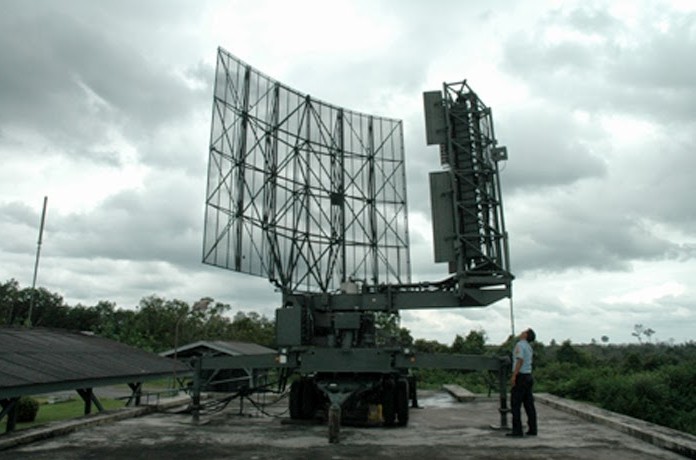
Radar is commonly used to achieve basic goals such as detecting the presence of an object in the distance, detecting the speed of an object, or mapping something. Although it is more considered as eyes, in truth the way radar works is like ears.
Radar works by using the principles of echo and Doppler shift. These two concepts are easy to understand if they are associated with sound, because the ears can hear echoes and Doppler shift every day. The technique used by radar is more or less the same. Only the waves emitted and received are radio waves.
An echo is an everyday event we can encounter. If we shout into a well or a valley, the echo will return a few moments later. An echo occurs because part of the sound waves from our shout hit a surface (water or the bottom of the well or the wall of the valley) and propagate back to the ears. The time between when we shout and when we hear the echo depends on the distance between us and the surface that causes the echo.
Doppler shift is also common, but we do not pay much attention to it. Doppler shift occurs when a moving object produces or reflects sound. In extreme conditions, Doppler shift can produce a sonic boom. If a car travels toward you at a speed of 100 km per hour while sounding its horn. You will hear the horn sound at one pitch. But when the car passes you, the horn sound shifts to a lower pitch. This difference in sound is the result of Doppler shift.
By using the echo of a sound, the distance of an object can be determined. And the Doppler shift of an echo can determine the speed of an object. So it is possible to make a “sound radar”. That is what sonar is like. Submarines and ships use sonar. The same principle also applies in the air. However, the propagation of sound waves in the air has several constraints.
Sound in the air cannot propagate far. At the farthest it only reaches one mile. Everyone can hear sound, likewise a “sound radar” would certainly disturb the environment. This disturbance problem is addressed by using ultrasound, not audible sound.
Apart from that, sound echoes are so weak that they are difficult to detect. To overcome these various constraints, radar uses radio waves, not sound waves. Radio waves propagate farther and are not visible or audible to humans. What is certain is that radio waves are easy to detect even if they are weak.
High Intensity Radar Waves
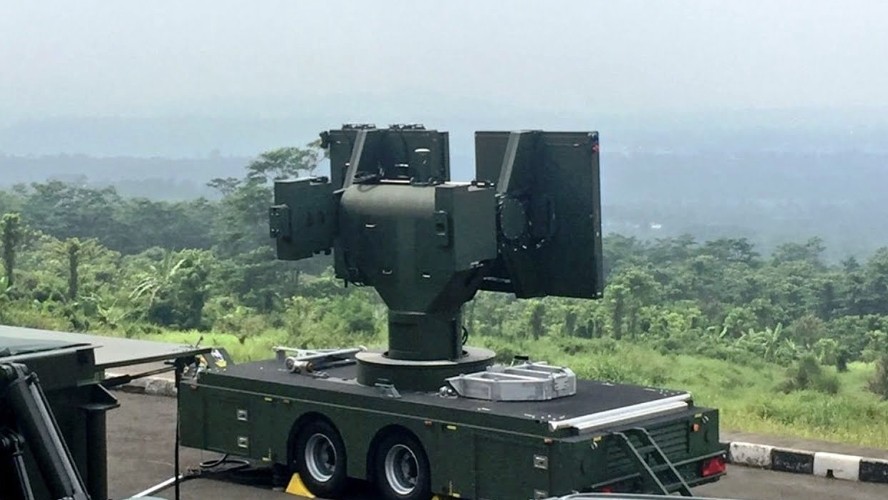
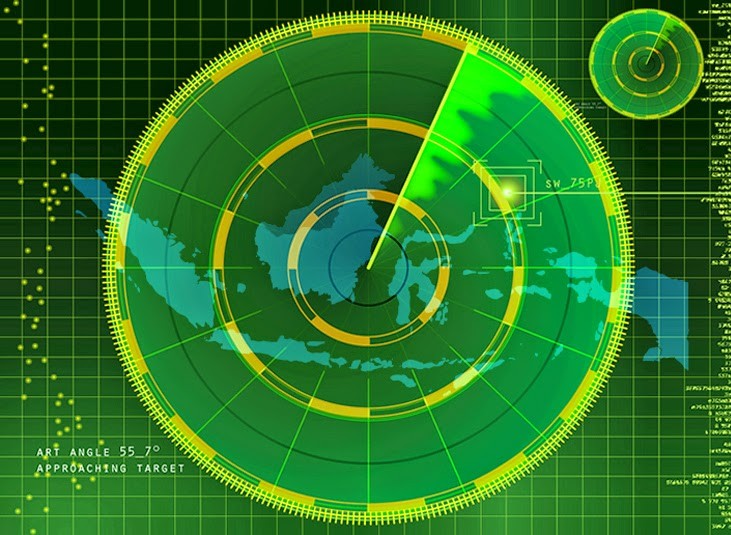
In general, the way radar works is by activating the transmitter. This transmitter emits short, high frequency radio waves with high intensity. The burst lasts in a matter of microseconds. The radar then automatically turns off the transmitter and activates the receiver, which listens to the echo resulting from the reflection of the object produced. The radar measures the time needed until the echo is heard, including calculating the Doppler shift of the echo. All of that happens very quickly.
Radio waves propagate at the speed of light, around 0.3 meters per microsecond. So, if the radar has a very fast timing system, the distance of an aircraft can be determined very accurately. Using special signal processing equipment, radar can measure Doppler shift precisely while determining the speed of the aircraft.
In short, the way radar works is that the radar antenna sends short, high power radio waves at a known frequency. When the waves hit a flying object, these waves bounce back. The same antenna is used to receive the weaker returning signal.
Compared with air based radar, ground based radar is more potentially subject to interference. When radar fires its waves, the incoming echo is the result of wave reflections on various objects such as fences, bridges, mountains, buildings, and others.
Then which reflection is worthy of being displayed on the operator’s screen? An easy way to eliminate this interference is by filtering out echoes that are not affected by the Doppler shift effect. Radar only pays attention to signals influenced by Doppler shift, and because the radar emission is precisely focused, the waves only hit aircraft.
That is the simple explanation of how radar works. On another occasion, AWACS, the flying radar that choreographs air battles, will be explained.