The Sea Harrier Version Is Born

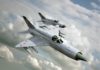
The Sea Harrier was a fighter jet specialised for operating at sea, with anti-warship weaponry as well as a reconnaissance role. Its existence added to Britain’s capability in the Malvinas (Falklands) War of 1982.
Thirty-eight Sea Harriers were sent to the war in the South Atlantic. Four aircraft armed with AIM-120 AMRAAM air-to-air missiles and Sea Eagle air-to-surface missiles were flown directly from Britain to Ascension Island. The journey to the island, 6,437 km away, took 18 hours there and back with the help of air-to-air refuelling. In the Malvinas War operations, three Harriers were declared lost, but their pilots survived.
The Sea Harrier, which had served long and faithfully in the ranks of the British Navy since 1978, was declared retired in March 2006. They were waiting for the arrival of the STOVL F-35 Lightning II fighter jet built by Lockheed Martin as a replacement. The reason was that the F-35 is multirole, has a longer range, flies longer and has stealth properties. The F-35 would be operated from the Queen Elizabeth aircraft carrier then under construction.
Meanwhile the Harrier GR7 had its capability upgraded to the GR9 over four years until its retirement in 2010. The upgrade included replacing the Pegasus 105 with the Pegasus 107 engine, which has greater thrust, so it could carry more bombs and missiles and still take off from an aircraft carrier. In addition, the GR9 was fitted with a new MIL-STD 1760 computer, a new INS, GPS, GPWS and a better display. A helmet sight would equip the GR9 to control its weapons and its state-of-the-art reconnaissance system. Sadly, on 24 November 2010, the entire British Air Force Harrier fleet was retired.