


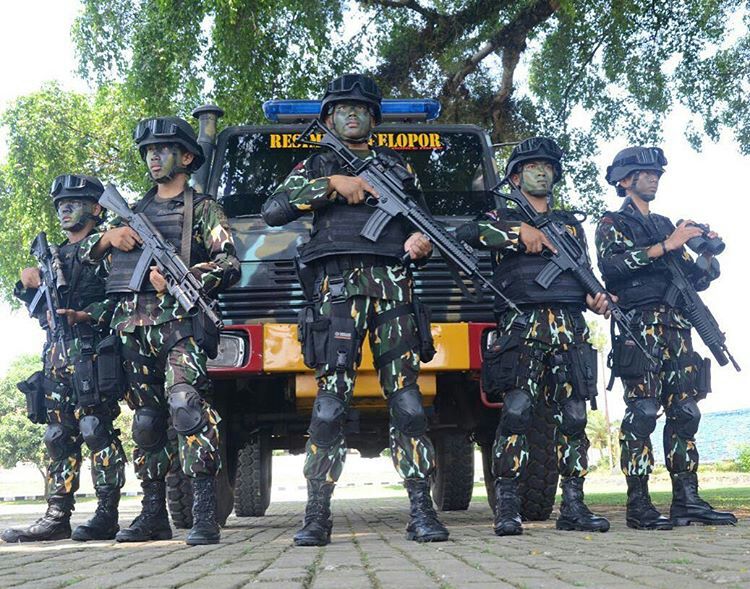
Profile of Brimob, the Indonesian Police Paramilitary Unit – HobbyMiliter.com – The Mobile Brigade Corps, often shortened to Korps Brimob, was born, grew and developed amid the struggle to win and defend the independence of the Republic of Indonesia. This police paramilitary unit has undergone several reorganisations of its structure and distribution of forces. Today Brimob consists of two pioneer-qualified units and one counter-terror unit.
The Mobile Brigade Corps is a descendant of the Gewepende Politie (Armed Police), a police paramilitary unit formed by the Dutch East Indies colonial regime (1912). The role of this law enforcement institution was then transferred to the Veld Politie (Field Police) as guardian of order and security in society (under colonial law) and to prevent insurgency in every colony. In early March 1942 the Veld Politie was disbanded by the Japanese military regime when Japan entered Indonesia. In its place, in April 1944, the Tokubetsu Keisatsu Tai (Special Police) paramilitary police unit was formed as a companion to the Keisatsu Tai (General Police).
Most members of the Tokubetsu Keisatsu Tai were indigenous people, former members of the Veld Politie. The Japanese military regime took this policy to win the hearts of indigenous people and to save the Japanese military regime time and effort because it did not need to train new police personnel.
Later, however, because the need for law enforcement officers in society kept growing, the Japanese military regime recruited more young people as police members. The Tokubetsu Keisatsu Tai in particular were also drilled in military science so that they would be ready at any time to be deployed as reserve troops supporting the Japanese army against Allied invasions.
The distribution of Tokubetsu Keisatsu Tai forces matched the number of residencies in the Dutch East Indies era. In each residency, operational control of this unit was in the hands of the regional police chief. The number of members per unit at residency level was 60–150 people depending on the size of the area of responsibility. This unit was led by an Itto Keibu (equivalent to a Police Inspector First Class).
For important regions such as Jakarta, Bandung and its surroundings, or Surabaya, the number of Tokubetsu Keisatsu Tai members could reach 200 people. The operational equipment of the Tokubetsu Keisatsu Tai covered almost all the assets of the Veld Politie plus several two-wheeled vehicles and light armoured vehicles granted by the Japanese military regime.



 was born, grew and developed amid the struggle to win and defend the independence of the Republic of Indonesia.)