

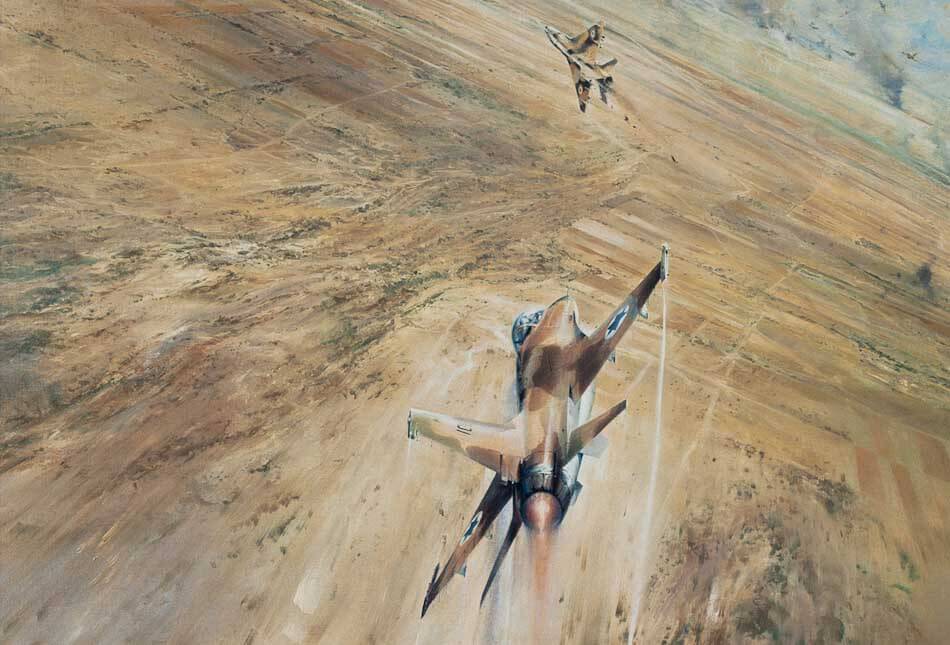
From that came the idea of launching a second assault, namely destroying the air defence missile system in the Bekaa Valley. Whatever the price to be paid. The reason was that if the shield of military power in the Bekaa were left in place, the PLO guerrilla attacks would keep happening. Every day, all year round.
The second assault was carried out with far greater force. For that purpose, on 9 June 1982 the Israeli Air Force launched 90 of its fighter jets in four formations, close together. At two in the afternoon, a group of F-4 Phantoms fired AGM-65 Maverick air-to-ground missiles at the radar stations and the SA-2 Guideline, SA-6 Gainful and SA-8 Gecko missile batteries belonging to Syria in the Bekaa. The air attack was supported by Ze’ef surface-to-surface missile fire from the Israeli Army. This assault was extremely effective, given that in only ten minutes, ten Syrian surface-to-air missile positions were knocked out.
Israel, however, did not want to leave any of that force intact. As a result, several air attacks were carried out until 11 June 1982, and the remaining air defence missiles in the Bekaa and Syria’s air power could be completely neutralised. For this, F-4s, A-4s and Kfirs were deployed to silence the missile network in the Bekaa, with close escort by F-16s and F-5s.